
Most months, Bubble co-founder and co-CEO Emmanuel Straschnov opens the floor straight to community questions. This time, he started somewhere else: with demos. Before taking a single question, Emmanuel walked through a batch of updates the team has either shipped recently or is actively building, from small quality-of-life language upgrades to an early look at one of the most requested features in Bubble's history. Then he moved on to the Q&A, which covered everything from AI model selection to July's platform outages.
Watch the replay below, or keep reading for a summary of everything he covered.
What Emmanuel demoed
New list operators, straight from community feedback
Emmanuel opened with two new operators added to Bubble's expression language, small updates that add up to real time savings for people building apps intensively. The :index of operator tells you where an item sits within a list; it previously only worked with custom data types like orders or users, but now works with basic types too, including text, numbers, and geographic addresses. The :converted to list operator turns a single entry, whether text, number, or custom type, into a list, useful for the many situations where two items being compared both need to be lists.
Emmanuel also says, "I want to give a shout-out here to Brenton from the community, because this came from him. Please keep bringing these things to us, whether it's on social, forum, or Slack."
The Agent can now add API calls on its own
The most in-depth demo of the day showed the Bubble AI Agent (beta) setting up an integration with Stripe from scratch. Previously, connecting to an external service like Stripe meant adding a plugin or building it manually with the API Connector. Now, you can ask the Agent directly.
Emmanuel prompted it to set up API calls to create a Stripe customer, create a subscription, and cancel a subscription, and the Agent researched Stripe's documentation, proposed a plan, and added the calls once approved.
"The Agent is actually capable of doing a lot of this, similar to what you'd expect from a coding agent like Claude Code," Emmanuel says. He noted this is already live for people with Agent access, although you do have to still manually initialize the calls before they're available as workflow actions.
This builds on other recent Agent additions, including the ability to create reusable elements in backend workflows, with support for conditions on elements in progress. "This is part of our effort to really make sure the Agent can do everything that you can do with your mouse and your keyboard," Emmanuel says.
Global expressions gets folders and smarter parameters, ahead of general availability next week
Bubble's global expressions, introduced about six weeks before this AMA, are getting two updates as the feature heads out of beta and into general availability next week. First, global expressions are getting a folder structure, matching the organization already available in the workflow tab, which particularly helps on larger apps. "The team just shipped this a few minutes ago," Emmanuel says. Second, parameter fields now support making a parameter optional, setting a default value, and adding a description, so the issue checker no longer flags a parameter as required when it isn't.
Emmanuel encouraged wider use of the feature: "I very much encourage everyone to use global expressions. Not only is this cleaner for debugging, it's also better for performance, because it creates a smaller application."
An early look at branching and loops in the workflow engine
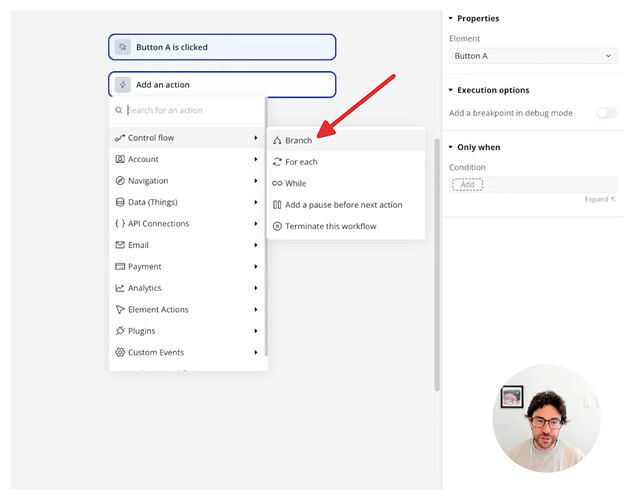
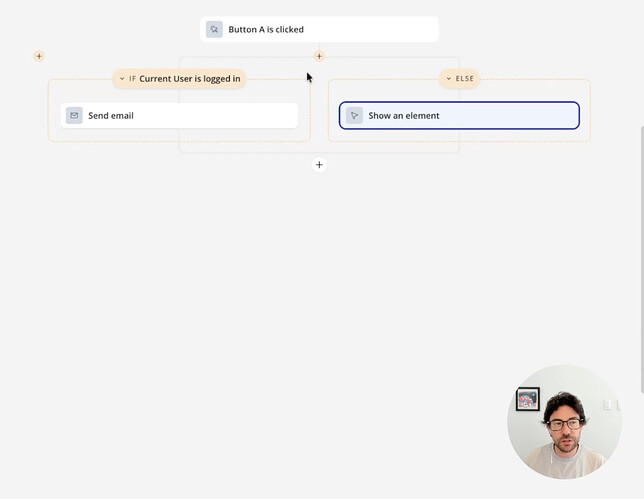
The most anticipated item on the list wasn't ready to ship, but Emmanuel wanted to show where it stands. Bubble is building branches and loops directly into the workflow engine: if/else conditions, for loops, and while loops, all inside a new control flow tab. Until now, conditions in Bubble could only be applied to a single action; this extends that logic across entire branches of a workflow.
"This is getting Bubble closer to traditional programming languages that are written with code," Emmanuel says, noting that as apps get more complex, builders often end up recreating this kind of logic with cumbersome workarounds involving recurring workflows. Shipping it natively is a bigger project than it might look: alongside the interface, the team is doing a broader overhaul of how the workflow engine executes at scale. Emmanuel said he'd been asked not to commit to a firm date, but called it the “medium term.”
Questions from the community
The Agent's rollout: mobile access and a deadline for every app
A community question asked whether the Agent would be able to edit mobile apps soon. It already is: rollout is underway, with roughly half of apps currently having access. Emmanuel explained the gradual pace is intentional. "We want to ensure the quality and the experience is good, and it's just safer to do that," he says, given how many production apps now run on the platform. The target is for every app, web or mobile, to have Agent access by the end of September.
More broadly, Emmanuel confirmed a deadline for bringing the Agent to all existing apps, not just those created through Bubble's AI generation flow: by the end of September or early October. In the meantime, anyone wanting earlier access can reach out to the Bubble team directly.
How Bubble decides which AI model powers a feature
Asked how the team chooses which large language model sits behind a given feature, Emmanuel described a three-way tradeoff between quality, speed, and cost. Using the most capable model for every task isn't always the right call, since heavier models are often the reason AI features feel slow. "You don't necessarily need the best one," he says. "You need good performance for a reasonably cheap cost." Model costs are a growing consideration industry-wide, and the team revisits these choices regularly as models continue to improve.
Who Bubble's AI features are really for
A question asked whether Bubble's AI features are aimed at beginners or more experienced developers. Emmanuel's answer: both, deliberately. Capabilities like adding reusable elements or backend workflows through the Agent skew toward experienced Bubble developers, while newer builders lean on the Agent to get a first version of an app off the ground. "There's a lot of overlap between the functionality of the Agent" for both groups, he says, and closing that gap is an active design challenge. He pointed to the broader shift already underway in software: teams that once needed 10 developers may now do more with the same headcount, or the same work with fewer people.
Bubble vs. AI coding tools, revisited
Asked again about Bubble's core advantage over AI coding tools, a recurring AMA topic, Emmanuel pointed to two things: the visual interface, and not having to manage hosting or DevOps. He used the new branching demo as an example. A nested if/else condition is straightforward to read visually, but genuinely hard to parse in raw code.
"The main challenge I see with AI coding tools is it's great at first," he says. "But then you have to actually understand what the code does, and that's one thing Bubble is much better at." AI makes code easier to write, in his view, but it doesn't remove the need to eventually read and maintain it, which is where Bubble's visual approach still holds an edge. He added that Bubble's own Agent needs to keep closing the gap with AI coding agents, and that's an active focus for the team.
How the internal team is using AI
A community member asked how Bubble itself uses AI day to day, and Emmanuel went team by team:
- Engineering relies most heavily on Claude, along with tools like Cursor, to help write and review code. "A lot of the code is actually not written by humans anymore," Emmanuel says. "It's written by AI, including reviews."
- Product and design teams use AI to speed up the traditionally manual work of synthesizing user feedback and survey results, freeing up time to focus on what to build rather than gathering information.
- Marketing uses AI throughout content creation, from images to text.
- The support team was an early adopter internally, with an AI-driven bot at bubble.io now resolving an estimated 60 to 80% of user requests automatically by combining AI-detected intent with internal automation.
- Finance, a comparatively small team relative to the size of the business, uses automation to handle work that used to require manual effort, letting the same team take on more valuable work rather than reducing headcount.
Emmanuel connected this to the pace of recent shipping: the concentrated release the team pushed out in early June was possible in part because of how much the team itself now leans on these tools.
Addressing July's outages
One question raised Bubble's recent reliability issues directly, asking whether that might push Bubble toward supporting self-hosting. Emmanuel was direct about the cause: July's outages traced back to a core piece of infrastructure that needs to be migrated, work that's now underway. He pointed to a forum post from Fede with more detail on the incident.
"I'll apologize for what happened over the last three, four weeks, because it has been more rocky than it should have," he says. Going forward, he described two priorities: upgrading the remaining single points of failure in the system, and strengthening automated testing, with internal postmortems (in addition to the public ones) driving changes after every incident. "One of the key things that makes Bubble different from the other tools, in particular the vibe coding tools, is the fact that we do have a platform that has been proven and run in production," he says. "We need to keep this trust from users."
A related question asked whether recent database architecture changes would improve performance. Emmanuel said that's always the intent behind infrastructure changes, though the effect isn't always a dramatic speedup since usage is growing at the same time. Sometimes an upgrade mainly prevents things from getting worse as load increases, rather than producing a visible jump in performance.
What's on the roadmap
Several other topics got shorter, direct answers:
An authorized MCP connector is being scoped now. Emmanuel said MCP connections can be used in a lot of different ways, so the team is still working out exactly what to build before committing to a timeline.
External LLMs building directly into Bubble (for example, using Claude or ChatGPT to generate an app that then imports into the Bubble editor) is something the team is actively exploring, with some early work already running internally. "We don't want to be a separate ecosystem that people cannot interact with," Emmanuel says. "Whatever we can do to allow external LLMs to build directly for Bubble, we will."
HIPAA compliance is still on track for this year, per Emmanuel, an important milestone for enterprise deals that typically run through Bubble's sales team.
Regional data centers, for markets like Europe, Brazil, and Australia where data sovereignty requirements are getting stricter, are in early infrastructure groundwork. Emmanuel didn't commit to a 2026 timeline for letting builders actually select a data center, but confirmed the underlying work is underway.
Editor performance and memory leaks on larger apps have a dedicated team looking into them. Emmanuel asked builders experiencing slowness to file bug reports with a specific reproduction case rather than a general description, since specific cases are far easier for the team to act on.
The mobile plugin editor beta, which lets builders create plugins using React Native libraries, has been live for about two months and is already seeing active use.
Smaller product requests also got a nod for the team to look into: tracking core token usage the way style usage is tracked today, tightening the reusable element right-click menu to prevent accidental deletion of nearby options, and a native glass tab bar for iOS apps.
Pricing, plans, and compliance questions
A few business-side questions rounded out the session. Asked about volume discounts for accounts managing many apps, Emmanuel explained that Bubble's decision, made roughly nine years ago, to price per app rather than per user was designed to support a fluid ecosystem where apps get shared and resold. Formal volume discounts aren't part of the self-serve plans today, though larger organizations with many apps can work out a negotiated deal through Bubble's sales team.
On cheaper regional pricing for South Asia and Africa, Emmanuel said Bubble's cost base is entirely in US dollars, which makes purchasing-power-adjusted pricing difficult to execute today. He noted this isn't unique to Bubble within the tech industry, and that the company will act if an economically viable path opens up, pointing to Bubble's long-standing user base across emerging markets, including Brazil (Bubble's second-largest market), India, Indonesia, and Southeast Asia.
On providing SOC 2 and GDPR documentation to help builders reassure their own clients, Emmanuel drew a distinction: Bubble's own SOC 2 Type II and GDPR compliance is separate from the compliance of the individual apps built on Bubble, which remains the builder's responsibility. Bubble's sales team can share relevant reports to support that conversation, and Emmanuel noted this tends to come up most with larger customers.
A final question about more advanced filtering options within Bubble's search functionality got a practical answer: because there are many possible ways to interpret "advanced filtering," Emmanuel asked builders to email the team with their specific use case so it can be properly scoped as a potential product improvement.
Wrapping up
A community member thanked Emmanuel and the team for Bubble's infrastructure and community support. Emmanuel redirected the credit: "It's really the entire team doing this," he says, pointing to how much of the day-to-day building and running of the platform now happens without him or Josh directly involved. He closed by reflecting on how much the AMA format has come to replace the hands-on forum presence he used to have in Bubble's early years, and thanked the community for showing up with so many questions.
Full question list with timestamps
0:04 — Welcome and introduction to today's demos
1:55 — New list operators: :index of and :converted to list
3:59 — Agent adds API calls demo begins (Stripe example)
5:43 — Agent finishes adding API calls; access and rollout status
7:52 — Global expressions: folder structure and new parameter fields
10:37 — Workflow engine preview: branches and loops
12:40 — Demo wrap-up, transition to audience Q&A
~13:00 — Will the Agent be able to edit mobile apps soon?
~14:00 — How does the team determine which models power which feature?
~15:30 — How do experienced Bubble devs think about Bubble AI features? Are they only for beginners?
~17:30 — What's the biggest benefit of building on Bubble vs. AI coding tools?
~18:00 — How is the internal team using AI?
~22:00 — Any thoughts on self-hosting, given recent outages?
24:25 — Will Bubble provide an authorized MCP connector?
24:52 — Is there a deadline for AI Agent access on old applications?
25:23 — Is HIPAA compliance still planned for this year?
~26:30 — Comment: loving global expressions
~26:50 — Will the latest database architecture changes improve performance?
27:35 — Are there plans to allow external LLMs to build directly?
~28:45 — Comment: branching/looping will help intermediate users too
~28:55 — Why can't global expressions access data from the page URL?
~30:30 — How are mobile plugins coming along?
30:56 — Any plans for a secrets vault to store encryption keys?
~32:30 — Would there be coupons or discounts for accounts with many apps?
~33:30 — Are there plans for region-specific data centers?
~34:30 — Are there plans to address editor performance and memory leaks?
~35:40 — How did you enjoy the World Cup third-place playoff?
~36:30 — Any tips for improving mobile performance and UX?
~37:00 — Are there plans for cheaper Bubble plans in South Asia and Africa?
39:43 — Could token usage be tracked the way style usage is?
~40:15 — Can the reusable element right-click menu prevent accidental deletion?
~40:45 — Are there plans for a native glass tab bar on iOS?
~41:15 — Can Bubble provide SOC 2/GDPR documentation for clients?
~42:45 — Are there plans for advanced search filtering?
~43:15 — Closing thanks and remarks
Build for as long as you want on the Free plan. Only upgrade when you're ready to launch.
Join Bubble