Launching your idea into the world is exciting. But what happens when you put months into building, press deploy, and nothing happens? The app works fine, but the issue is that the audience just hasn’t found it yet.
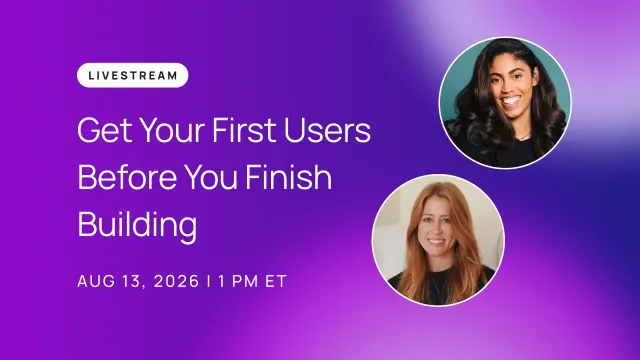
Our latest Launch Lab fireside chat covered this and more. Emmelie De La Cruz, Bubble's growth marketing lead, sat down with Vendela Colavecchio, design director at thoughtbot, a product design and development consultancy that's helped founders launch software for more than 20 years.
Their advice is to build less and launch sooner, because the market can't react to what it hasn't seen. And keep watching to the end for the questions our community asked, from pricing a SaaS to salvaging a half-built MVP.
Launch before you’re ready
Vendela opened the chat with the trap she sees most often. Bubble makes it easy to keep adding, keep refining and tweaking. So you do, for months, but nobody outside your laptop has reacted to any of it.
After launching products with a lot of founders and clients, Vendela says one thing stays true on every project is that once you launch, users will surprise you. You’ll run into bugs that turn out to be edge cases you didn’t predict, and sometimes the most-requested feature is something completely unexpected. You want to learn about those things sooner rather than later.
So her advice is to ship sooner and more often than feels comfortable. The mindset shift underneath it is treating every release as an experiment designed to teach you something instead of delivering a finished product.
Four practices from thoughtbot's playbook
Vendela walked through four practices thoughtbot uses to work out what to build and when a product is ready to go live.
Make an assumptions board
Every product involves assumptions about who your user is and what they'll pay for. Write down anything that sounds like an assumption, then turn the list into a table with the assumption, how you'll test it, and the metric that tells you whether it's true. That middle column becomes your road map of experiments. And if you're a subject matter expert in the industry you're building for, be extra careful here. Years of your own experience are easy to mistake for evidence.
Run cheap experiments
An experiment tells you whether the thing you're promising is the thing people want, and most experiments don't need a working app. Put your messaging on a landing page and measure signups, or run the same value prop as an ad and watch the click-through rate. Fake buttons that lead nowhere work too and only take minutes to set up.
Keep a back burner board
Once you start experimenting, good ideas pile up, and every one of them pushes your launch further out. When an idea is worth doing but doesn't solve the problem in front of you, park it on the board and keep going. Emmelie asked whether it's worth sharing that board with users. Vendela's advice is to keep it private this early, then compare it against what people raise on their own. Her rough measure is that five people mentioning the same parked idea is enough to move it up the list, while a single request usually isn't.
Launch, learn, then do it again
Your first launch is really testing whether your value proposition holds up, and you don't need the whole solution for that. Get one small piece of it live, watch what people do with it, and let their behavior set the next build. It's a loop rather than a checklist, and thoughtbot keeps running it with clients long after the first version goes live.
Waitlist pages over coming soon pages
For the second half of the session, Emmelie turned to what happens outside the editor, starting with the case against coming soon pages. A countdown timer adds friction instead of interest.
A waitlist page does the same job, and it collects information for you. People can sign up while you're still building, which tells you whether demand exists before you've finished. Promote a page for a few weeks and get three signups, and you've learned something useful about your positioning.
Three types of app waitlist pages
Which style you use depends on the product:
- Early access with a short application suits a premium product, where exclusivity is part of the appeal and a few questions help you screen who gets in.
- A chronological list is the simplest to run, letting five or more people through at a time in the order they signed up.
- A referral-only list is how Uber and Clubhouse grew, and it turns your ideal customers into the people recruiting the next ones.
Whichever you pick, Emmelie's page formula has four parts:
- The mirror: A headline that names the user or the pain point, so the right person knows it's for them.
- The promise: The outcome in one plain sentence.
- Preview and proof: A screenshot, mockup, or short demo, plus a couple of quotes if you have early users.
- The CTA: An email field and one useful question.
Specificity is what makes all four work, because it's also what makes you discoverable.
What to build first
Emmelie asked how to sequence features: in the order people will use them, or lead with the big idea? Vendela's answer was to start with the riskiest thing, the piece that sets you apart. That standout feature is where you find out whether the business works or needs a rethink, so test it as early as you can.
The rest of the build order can come from your waitlist. The answers people give at signup should do two jobs: tell you what to build next and hand you the words for your marketing. Keep the form to a single question, and choose the type based on what you need to learn:
- A pain point question tells you what to prioritize.
- An outcome question tells you what result people expect, which is what drives activation and churn. When expectations don't match reality, people leave and go find something else.
- A current process question tells you what they do today. If someone takes five steps to solve a problem and your app does it in one, that gap is your marketing. It's the reason Canva's pitch works with images, copy, and collaboration all in one place.
An extra question does add friction, so ask it after you've captured the email. Save the address on submit, then ask the question in a pop-up window.
Get it in front of people, then listen
Once your waitlist page is live, give it a custom domain before you promote. A random subdomain and a Gmail address make people hesitate before handing over an email. Skip the phone number field too, since few people will fill it in this early.
More importantly, promote while you build. Bubble's launch kit helps you make promo assets, and posting features as you ship them shows your ideal customer you speak their language. Small paid tests on Meta or TikTok tell you which version of the problem lands, and for B2B, LinkedIn lets you find the exact people you're building for and just ask.
Then let what people say become your copy, from their complaints to wishes. Build, get feedback, fix, and go again. Fourteen years in, here at Bubble we're still running that loop on our own product.
The Q&A in the livestream covered the rest, from a competitor copying you to pricing a SaaS and signing your first ten merchants.
Keep going
Everything here comes down to launching before you feel ready, then letting real users shape what comes next. If that's the stage you're at, that’s exactly what Launch Lab is built for. It's a free, guided cohort that takes you from idea to a live, deployed app in 30 days, with weekly expert sessions, hands-on build support, and a chance to win up to $4,000 along the way.
Build for as long as you want on the Free plan. Only upgrade when you're ready to launch.
Join Bubble