
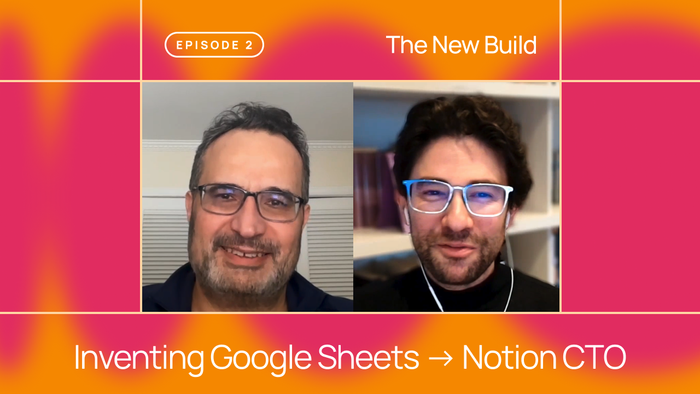
Fuzzy Khosrowshahi is the CTO of Notion, the co-creator of Google Sheets, and former head of product engineering at Slack during the pandemic. In this episode of The New Build, Bubble co-CEO Emmanuel sits down with Fuzzy to unpack lessons from building productivity tools used by hundreds of millions of people — including why bundling beats single-product focus, what Slack could have done differently as an independent company, and his honest take on vibe coding.
Watch or listen:
- Watch on YouTube
- Watch on Spotify
- Listen on Apple Podcasts
About Fuzzy Khosrowshahi
Fuzzy Khosrowshahi is the CTO of Notion, where he oversees engineering for one of the most beloved productivity tools in the world. Before Notion, he spent over a decade at Google where he co-created Google Sheets after the company acquired his startup. He then led product engineering at Slack during the pandemic-driven remote work explosion. Fuzzy is known for his user-centric approach to product development and his belief that the best leaders surround themselves with experts rather than pretending to know everything.
What you'll learn in this episode
This conversation is packed with hard-won lessons from someone who's built products at the highest level. You'll learn why bundling multiple products into a suite creates defensive moats that single-product companies can't match — and how Microsoft, Google, and now Notion have used this playbook to win. Fuzzy breaks down what happens to product velocity when a startup gets acquired by a larger company, drawing on his direct experience at both Slack and Google. He shares the specific customer validation moment that told him Google Sheets had real traction, and explains why speed to prototype matters more than perfection. You'll also get his honest assessment of vibe coding: what the current tools get right, where they fall short, and why he believes good engineers will remain essential even as AI improves.
Episode timestamps
[00:00:00] Introduction: Fuzzy's path from life insurance to Notion CTO
[00:02:54] How running a Subway franchise shaped his approach to management
[00:07:26] The banking insight that sparked the idea for web-based spreadsheets
[00:11:23] Getting acquired by Google and the early skepticism about Sheets
[00:14:22] Leading Slack during COVID and whether it reached its full potential
[00:19:41] Why Notion is winning against Google and Microsoft
[00:22:47] The bundling strategy: why suites win and whether AI changes that
[00:30:36] His honest take on vibe coding and why good engineers still matter
[00:36:10] Advice for builders: ship fast, validate fast, never rest on your laurels
[00:38:17] Outro: Prototype to Profit cohort and in-app purchases announcement
Key insights from this episode
The fastest path to validation is building something you can use yourself
When Subway wanted to charge Fuzzy $2,000 for their ledger system, he taught himself Excel and replicated it instead. That decision sparked a deep expertise that eventually led to Google Sheets. His core advice for builders: get something working as fast as possible so you and the people around you can actually use it. Too many founders try to make things perfect before shipping, and by the time they launch, someone else has built something different and better.
Bundling creates defensive moats that single products can't match
Microsoft Office won through bundling acquired products together. Google Workspace succeeded by combining Gmail, Calendar, and Docs into a unified suite. Notion is following the same playbook with mail and calendar integration. The strategy works because once users adopt multiple tools in a bundle, switching costs multiply. Even if a competitor builds a better individual product, users won't leave if they're getting value from other parts of the suite. However, Fuzzy notes that AI and MCP servers may change this calculus — if agents can connect to any app, the UI bundle matters less.
You don't need to be an expert if you surround yourself with them
Fuzzy openly admits he's not an AI expert, even though AI is central to Notion's strategy. His approach: acknowledge what you don't know, then surround yourself with people who do. At Notion, co-founder Simon Last focuses entirely on AI and forward-looking technology. Fuzzy's job isn't to be the smartest person on AI — it's to listen to experts, stay out of their way, and make sure the company executes on what they recommend. This humility has served him across three major companies.
References
- Notion — The all-in-one workspace where Fuzzy serves as CTO
- Google Sheets — The spreadsheet product Fuzzy co-created after Google acquired his startup
- Slack — The workplace communication platform where Fuzzy led engineering during the pandemic
- MCP (Model Context Protocol) — The protocol Fuzzy references for connecting AI agents to different applications
- Join our Q1 launch program, From Prototype to Profit
- RSVP for Emmanuel’s next live AMA on February 12
Listen and subscribe
The New Build is a bi-weekly podcast exploring how solo founders and small teams are building products that reach millions of users. New episodes drop every other week.
Subscribe: YouTube · Spotify · Apple Podcasts
Build for as long as you want on the Free plan. Only upgrade when you're ready to launch.
Join Bubble