

Every once in a while, we learn about a business using Bubble that stops us in our tracks. Meeting the team at Airspace was one of those moments.
Airspace is a logistics company that specializes in moving things as fast as humanly possible, often by taking advantage of empty cargo space on commercial flights. When a shipment is time-critical, Airspace uses proprietary routing software and a network of independent partners to get it where it needs to be, when it needs to be there. But when Senior Manager of Revenue Operations Kory Hunter learned of a potential new Airspace customer that needed to get human organs to hospitals quickly and reliably, he realized there was an opportunity to not only win new business, but also help save lives: Bubble.
The organ procurement company needed to have confidence that their logistics provider could triage and execute based on details like the organ’s time-sensitivity, condition, and location — so Kory and team turned to Bubble to quickly demonstrate how a user interface might look and function in this unique scenario. In less than a month, they had a working product and Airspace had a new customer to the tune of millions in ARR.
Airspace’s Bubble journey doesn’t stop there. They’re actively working with the organ donation company to scale across the United States, estimate they’re on track to facilitate at least 3,500 organ and tissue donations annually, and even have new Bubble apps in development with other logos in the medical field.
From expensive idea to practical solution
Kory doesn’t have a technical background, but he’s long been an action-oriented tinkerer. “I used to build websites as a side gig,” he explains. In his “actual job” of managing a customer relationship management (CRM) database and developing budgeting tools, he picked up a bit of technical expertise. Still, he was hardly a coder, and knew that it would be time- and resource-intensive to build out the idea “the traditional way” with Airspace’s internal engineering team.

Ever the problem-solver, Kory discovered no-code tools thanks to a few quick Google searches. Bubble stood out, in part because he was able to start building on the Free plan right away.
“I was able to go in and create the rough sketch of the application that I needed without having to put [in] any payment.”
“I was able to go in and create the rough sketch of the application that I needed without having to put [in] any payment,” he recalls. “I had probably 85% of the product done and showcaseable just through the preview environment. We didn’t have to make any commitments until the product was fully ready.” Kory’s effort — from knowing nothing about Bubble to building that “fully ready” app — took only about three weeks.
Building on the Free plan allowed Kory to learn, iterate, and incorporate feedback before upgrading plans so he could host and deploy — almost like a pre-production staging environment. With the help of his colleagues, Vishesh Bansal and Jake Vanus, he was able to connect the visual interface to backend APIs. From there, “it really was just plug and play.”
Saving lives through batch processing
The solution Kory built enables one of the largest organ procurement organizations in the United States to transport donor organs — known as “gifts,” in industry parlance — to research facilities and recipients in need.
In practice, when someone passes away, gifts from the donor need to get dispersed extremely quickly. One donor might have, for example, 12 gifts that need to be routed appropriately. The Airspace solution that Kory developed on Bubble enables multiple gift shipments to be placed and routed instantly, rather than one by one — a lifeline when time is of the essence.
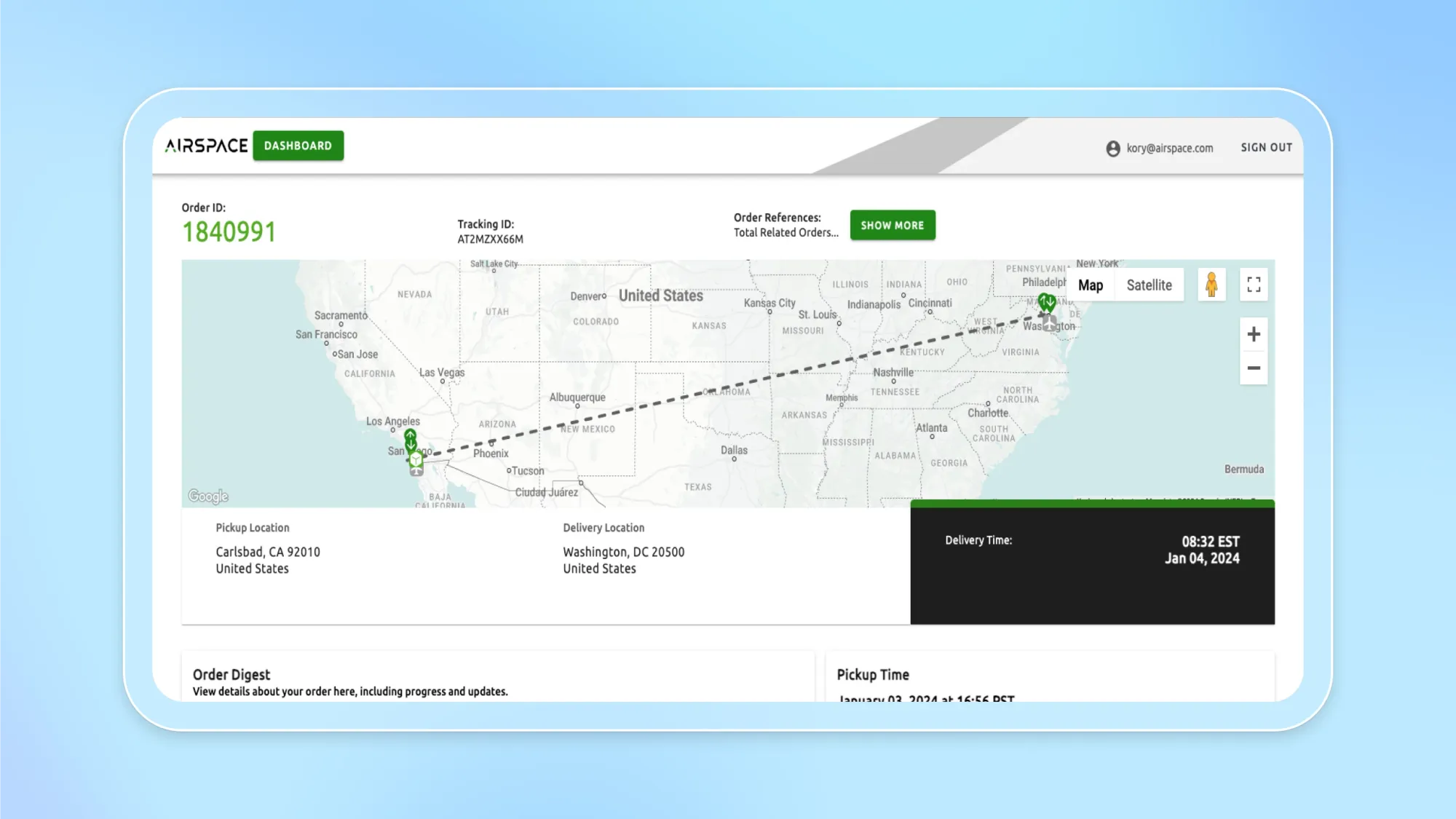
“There’s a viability window of how long these organs can be out of bodies,” Kory emphasizes. “What we were able to do was create a frontend experience for the team to be able to interface with [the Airspace] API and create multiple orders from one single origin instantaneously.” Kory estimates that without the batch order process in place, it could take upwards of an hour to create individual gift orders manually, with all their reference information — a consequential time-suck when the clock is already ticking.
“[Bubble’s] reliability is not only impressive but reassuring, making it a trusted platform capable of handling critical systems like orchestrating human organ donations.”
With a simple form that posts to the Airpsace API, the process isn’t only made more efficient — it’s made to save lives. Kory even incorporates user management best practices and anonymized IDs to ensure the platform is HIPAA compliant. In the last month alone, Airspace and their client helped get 300 gifts to their destinations on time.
“[Bubble’s] reliability is not only impressive but reassuring, making it a trusted platform capable of handling critical systems like orchestrating human organ donations.”
Expanding life-saving logistics
Eight months since launch, the product is doing all it set out to do and more: The process has been working so well that Airspace and their customer are mobilizing to expand. “We just added the complicated part of New York City just this past month, which has nearly 100 different hospital that we’re servicing,” Kory shares. “We started out with just one region and now we’re puzzle-piecing the rest of the United States.”
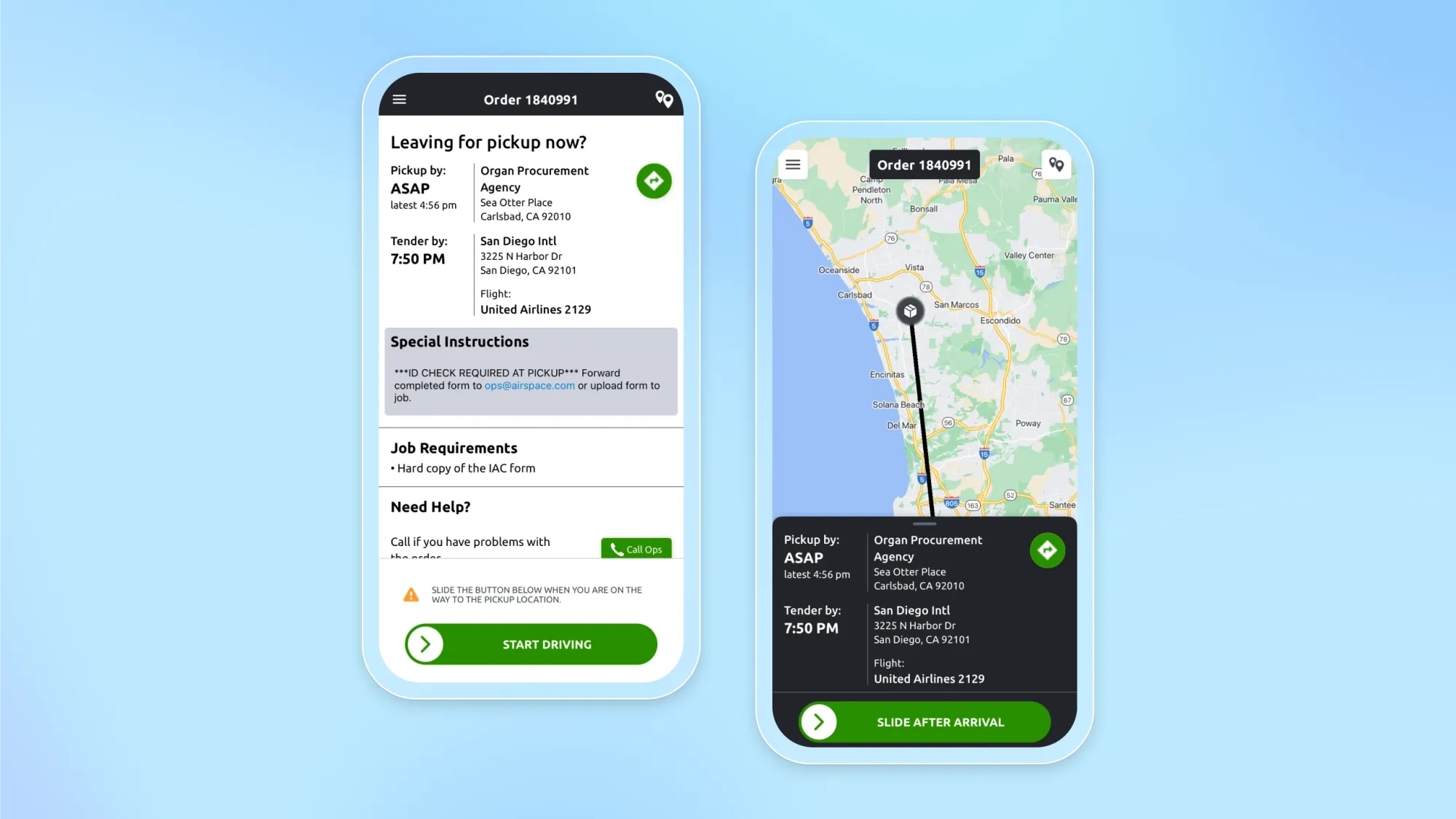
Knowing what he now knows about Bubble, Kory has “staged” four other product solutions in the Bubble preview environment in an effort to bring in new business for Airspace. “We’re doing a very different use case for medical device companies,” he shares.
For example, when someone needs a hip replacement, they don’t just need an artificial hip — there are “upwards of 200 to 300 different instruments and materials” needed to make the procedure safe and sterile. Airspace is creating a solution to manage those stops, which means drivers will be able to pick up and deliver orders of surgical instruments more efficiently.
Beyond bringing in new business, Kory is also using Bubble to build metrics dashboards for Airspace customers. “We’re using Bubble as a frontend reporting platform… so we’re able to get all of our active shipments for a client and then show them and manipulate [data] in a really cool dashboard that is much more configurable than something like Looker or Tableau,” he says.
Thinking back on the Bubble learning curve, Kory credits Vishesh and Jake with helping him connect the frontend and backend as he was coming up to speed. “It just points to how easy the platform is. If we had to build something comparable natively within our system, we’d have to bring in at least six people, and that’s a really expensive project.”
“If we had to build something comparable natively within our system, we’d have to bring in at least six people, and that’s a really expensive project.”
Vishesh agrees: “Bubble’s no-code framework helps us explain to anyone what’s going on behind the scenes and makes it easy to integrate with custom APIs without years of programming experience. For us, building innovative solutions using Bubble is an amazing way to onboard and retain new customers.”
With Bubble, though, Airspace can more strategically allocate internal resources while winning new clients and servicing existing business. The organ procurement organization represents a multi-million-dollar annualized contract for Airspace — a remarkable partnership that began with one revenue ops guy looking at a problem and thinking maybe — just maybe — there was a better way to solve it.
Build for as long as you want on the Free plan. Only upgrade when you're ready to launch.
Join Bubble