
Most vendors marketing platforms to enterprise companies claim to be production-ready and built for scale, but those terms can mean very different things. Even “enterprise AI platform” itself gets stretched to cover very different products: infrastructure you build on top of, tools that handle prompts and evals, or something that generates the finished app for you. Choosing the wrong one creates expensive lock-in and delays your AI initiatives by months.
This guide clarifies what an enterprise AI platform actually is, outlines the core capabilities to evaluate, and compares seven leading platforms on four criteria: which AI models each one supports, governance, deployment, and speed to production.
Why enterprise AI platforms matter for dev teams
When every team spins up its own AI experiment, none of it scales. You end up with people using tools nobody approved, no consistent rules for who can see what data, no record of what the AI actually did, and nobody watching for cost creep.
An enterprise AI platform gives every team a single shared system. It manages access, keeps a record of AI decisions, and handles compliance automatically, so no team has to write their own access-check logic and audit trail every time they ship a new AI feature.
For dev teams, this really comes down to speed. If a platform has solid developer tooling, handles data access correctly, and makes deployment straightforward, your team spends time shipping features, not building security scaffolding or chasing data-access bugs.
What is an enterprise AI platform?
Enterprise here means scale: AI that works across many teams and users, not just one person working alone. An enterprise AI platform is what makes that scale manageable: It brings data, security, and governance together so a company can build and scale AI apps across the business. Instead of a patchwork of disconnected AI tools, you get one system that controls who can access company data and keeps a record for compliance audits.
This differs from:
- A standalone AI tool, like an employee using ChatGPT on their own without IT involved, isn’t tied into how your company manages data, identity, or audits. Enterprise versions of tools like ChatGPT do add real governance and security, but that’s a different product from the consumer version most people default to.
- A raw API, like OpenAI’s API by itself, is a building block, not a finished platform. You’d still have to build the governance, security, and deployment around it yourself.
- A product-specific copilot, like Copilot in Word, helps you draft and rewrite inside that one product. Microsoft 365 Copilot reaches further across the suite, but it’s still a helper built into existing software, not a platform for building new AI applications from scratch.
A true enterprise AI platform includes four core layers that work together:
- Data layer: Connects to your company’s data and only lets AI see what a given user is actually allowed to see.
- Model layer: Works with multiple LLMs (large language models), so teams can switch or route between them without rebuilding workflows.
- Governance layer: Keeps an eye on model behavior, enforces usage policies, and logs decisions for audits and compliance.
- Application layer: Gives you the tools (visual builders, SDKs, APIs) to actually build AI-powered applications on top of everything else.
Knowing these four layers makes it easier to see what a vendor actually delivers versus what they just promise.
What to look for in an enterprise AI platform
Enterprise AI platforms generally split into two types. Infrastructure-first platforms provide the model, data, and governance foundation teams build on, while application delivery platforms provide the layer users interact with directly.
Most platforms here provide infrastructure you build on top of. That’s what most AI vendors build for enterprise companies.
Vellum is a specific tool to make the AI you already work with better. Bubble generates the app itself, and your team gets visual control over design, data, and logic.
Infrastructure platform criteria
Permission-aware RAG. RAG stands for retrieval-augmented generation — the AI retrieves relevant documents from your company’s data before generating a response, grounding answers in what your organization actually knows. It also checks permissions the moment someone asks a question, so a sales rep can’t pull up financial records only the finance team is allowed to see.
Multi-model support. A handful of providers handle most enterprise LLM usage, according to Menlo Ventures’ enterprise AI research, which means real exposure if one of them raises prices, changes a model, or goes down. If a platform lets you route queries to different LLMs without rebuilding your workflows, you’ve got options when that happens.
Deployment flexibility. See if the platform can run inside your own VPC (virtual private cloud, a private slice of a cloud provider’s infrastructure), meet your data residency requirements, or go fully on-premises for workloads that can’t move to the public cloud.
Governance and auditability. You’ll want tools that watch how the model behaves in production, log its decisions for compliance audits, and lock down access to sensitive operations. Gartner research found that organizations using AI governance platforms are 3.4 times more likely to achieve high governance effectiveness than those that don’t. That’s worth weighing if you’re in financial services, healthcare, or government.
Developer experience. This comes down to SDK quality, CI/CD integration, versioning, and rollback support. The same goes for agent orchestration: If the platform supports AI agents, look at whether it handles memory, tool use, and human-in-the-loop approval gates. Deloitte’s State of AI in the Enterprise research found that only one in five companies has a mature governance model for autonomous agents, so platform-level controls matter.
Cost controls. Per-run visibility, token budgets, rate limiting, and usage alerts are what keep a successful pilot from turning into a surprise bill at scale.
Application delivery platform criteria
App generation. The best platforms let you generate a working application from a description (UI, database, workflows, and logic) instead of starting from a blank canvas. The faster you can get to something testable, the faster you can iterate based on real user feedback.
Visual editing and control. AI generation gets you started, but you’ll usually need to refine the result yourself. The best platforms give you full visibility into how the app works and let you edit any layer (design, data, workflows, logic, privacy rules) without going back to a prompt.
Built-in security and governance. This means SOC 2 Type II compliance, SSO, and privacy rules you can configure without writing backend code. For enterprise teams, these aren’t optional extras. They’re what makes the app deployable.
Hosting and deployment. The platform should handle hosting, auto-scaling, and deployment so your team isn’t managing infrastructure separately. One-click deployment and built-in version control reduce the overhead of keeping a production app running.
How enterprise AI platforms are priced
Most enterprise AI platforms price one of two ways: You pay for what you use, or you sign an agreement upfront. Knowing which one you’re dealing with helps you forecast costs and avoid a surprise bill down the road.
Consumption-based pricing charges you for what you use, usually per token for model inference, plus extra hourly or usage-based fees for things like vector databases, data pipelines, and agent orchestration. It’s a good fit if you’re starting small, but costs can climb fast once real traffic hits your application.
Subscription and enterprise agreements trade some of that flexibility for predictability. You typically commit annually in exchange for dedicated capacity, deeper governance features, and custom infrastructure. If you’re running something mission-critical, that predictability, plus the built-in security, is often worth more than pay-as-you-go pricing.
The 7 best enterprise AI platforms for dev teams at a glance
Before we get into each platform, here’s a quick side-by-side look at primary use case, deployment options, governance, and whether an application layer is included.
| Use case | Deployment | Governance | App layer | |
|---|---|---|---|---|
| Microsoft Foundry | Infra + apps on Azure | Azure cloud | Entra ID Defender Purview |
❌ |
| AWS Bedrock | Infra + managed agents | AWS cloud with PrivateLink | IAM KMS CloudTrail |
❌ |
| Gemini Enterprise Agent Platform |
Infra + BigQuery apps | GCP cloud | GCP-native controls | ❌ |
| Databricks Mosaic AI | Custom models, lakehouse data | Multi-cloud | Unity Catalog permissions | ❌ |
| IBM watsonx | Hybrid/on-prem governance | IBM Cloud, AWS, on-premises | Model evaluation and tracking | ❌ |
| Vellum | Prompt mgmt + evals | Vellum Cloud | Observability and versioning | ❌ |
| Bubble | Visual app builder | Managed hosting | SOC 2 Type II Visual privacy rules |
✅ |
The 7 best enterprise AI platforms for dev teams
The first five platforms give you infrastructure that your teams can build apps on. Vellum is a specialized tool for testing and improving how you prompt the AI you already use. Bubble lets you use AI to build a finished, working app, with security and auto-scaling built in and no code required.
1. Microsoft Foundry: Best for governed multi-model development on Microsoft Azure
Microsoft Foundry is Microsoft’s unified platform for building, evaluating, and deploying AI applications. It’s the successor to Azure AI Foundry and is still hosted within the Azure ecosystem.
Foundry connects to OpenAI models through Azure OpenAI; it also supports Anthropic models and open-source models via the model catalog, plus fine-tuning support.
For organizations already running on Azure, Foundry connects to Microsoft Entra ID for identity management and works with Defender, Purview, Azure Monitor, and API Management for security and observability. That covers much of the compliance scaffolding you’d otherwise assemble yourself.
Developer tooling includes Python SDKs and REST APIs, plus preview GitHub Actions support for AI agent evaluations. Microsoft has also offered Prompt Flow in the Foundry classic portal for LLM workflow development, though this area moves fast, so confirm current tooling and naming before you finalize anything.
The main constraint is ecosystem dependency. Integrating data from outside Azure, like AWS S3 or Google Cloud, takes real engineering work, and teams unfamiliar with Microsoft’s tooling conventions will need time to get up to speed.
Best for:
- Organizations running on Microsoft Azure or Microsoft 365 with data in SharePoint, Azure Blob, or SQL databases.
- Dev teams that need governed access to OpenAI models with enterprise security controls already in place.
- Teams building RAG-powered applications where the knowledge base lives in Microsoft’s ecosystem.
- Organizations with existing Azure DevOps or GitHub Actions pipelines.
Limitations:
Tightly coupled to Azure, so multi-cloud setups or non-Azure data sources require additional integration work.
Pricing:
Consumption-based across the Azure and Microsoft Foundry services and models you use. It’s worth checking whether any separate platform fees apply to your specific Foundry configuration.
2. AWS Bedrock: Best for private model customization and managed agents on AWS
Amazon Bedrock gives your team API access to foundation models, the large, general-purpose AI models like GPT or Claude that power most AI applications today. AWS runs the infrastructure for you, so you don’t have to spin up GPU clusters or manage model servers yourself. Check AWS’s documentation for the current list of foundation model providers and the specific models each one offers, since this changes often.
Bedrock Agents help you build multi-step AI agents, Bedrock Knowledge Bases handle RAG by pulling from sources like S3, Confluence, Salesforce, and SharePoint, and you can fine-tune models on your own proprietary data. Everything runs inside your AWS account, with private connectivity through PrivateLink keeping inference traffic inside your VPC.
Fine-tuning data stays within the AWS network. It’s encrypted in transit and at rest, and protected by AWS access controls. Retention and sharing terms vary by provider, so check them for whichever model you plan to customize.
Bedrock Flows also gives you a visual workflow builder for linking prompts, agents, and AWS services, though your team has to build the actual end-user application on top.
Best for:
- Organizations running on AWS with data in S3, RDS, or other AWS services.
- Dev teams that need VPC-isolated model inference with AWS-native access controls.
- Teams building multi-step AI agents with governed access to internal knowledge bases.
- Regulated industries with strict data residency and isolation requirements.
Limitations:
The application layer is your team’s responsibility. Teams new to AWS should expect a ramp-up period.
Pricing:
Pay-per-token for model inference. Knowledge Bases and Agents have separate usage-based costs. No platform subscription fee.
3. Gemini Enterprise Agent Platform: Best for BigQuery-native AI apps and agent builder
Google’s platform is now Gemini Enterprise Agent Platform, formerly Vertex AI. Google renamed it in April 2026, and older Vertex AI terminology may still appear in existing documentation and user references. It includes access to Gemini models, open-source models via Model Garden, and tools for RAG, fine-tuning, and agent creation.
If your source of truth is in BigQuery (Google’s cloud data warehouse), the platform connects to it directly, which is useful if you need AI grounded in structured enterprise data. Agent Builder also gives teams a simpler path to shipping conversational agents and search applications without deep machine learning (ML) expertise.
The platform includes MLOps tooling for managing the model lifecycle beyond inference. Check that access controls behave as expected for your specific data setup before finalizing your architecture.
Like the other cloud-native platforms here, this one is built for teams already on GCP. Bringing in data from outside Google Cloud adds complexity, and teams with existing OpenAI dependencies should weigh the cost of switching to Gemini as their primary model provider.
Best for:
- Organizations on Google Cloud with data in BigQuery, Cloud Storage, or Google Workspace.
- Dev teams building search or conversational AI applications grounded in structured enterprise data.
- Teams that need MLOps tooling alongside model inference, including pipeline management, feature stores, and vector search.
- Organizations using Google Workspace who want AI grounded in Workspace data. Worth confirming current connector support and permission behavior in the documentation.
Limitations:
GCP dependency makes multi-cloud setups more complex. Teams evaluating multi-step agent workflows should test Agent Builder directly against their requirements.
Pricing:
Consumption-based. Gemini model inference is priced per token, with separate usage costs for platform services like pipelines and monitoring.
4. Databricks Mosaic AI: Best for lakehouse-native RAG and fine-tuning on proprietary data
Mosaic AI is Databricks’ AI and machine learning toolset, built into its Lakehouse Platform (its combined data warehouse and data lake). It lets data and ML teams fine-tune LLMs on proprietary data, build RAG pipelines, and serve models at scale, all without leaving Databricks.
If your most valuable data lives in Delta Lake (Databricks’ open-source storage format), Mosaic AI integrates tightly with it through Unity Catalog, which governs permissions, auditability, and lineage, so the AI only accesses what it’s allowed to and everything it touches gets logged. That kind of governance matters most in regulated industries where auditors need full visibility. It’s also worth checking Unity AI Gateway’s rate limiting and credential management for your specific setup.
This is a platform for data scientists and ML engineers. Teams can train and deploy custom models, including fine-tuned open-source models, without leaving Databricks.
For application teams that need to move faster, Databricks is typically paired with a separate application delivery layer rather than used as a standalone path to production. The platform is built for the data and model layer, not the UI or user-facing app.
Best for:
- Organizations with significant data already in Databricks, Delta Lake, or a broader Lakehouse architecture.
- ML engineering and data science teams building custom or fine-tuned models on proprietary datasets.
- Dev teams that need RAG grounded in governed enterprise data with column- and row-level access controls.
- Organizations in regulated industries that need fine-grained audit trails on AI data access.
Limitations:
This isn’t built for shipping applications quickly. Your team still has to build the application layer separately, and getting real value out of fine-tuning takes actual ML engineering skill.
Pricing:
Databricks Unit (DBU) consumption-based pricing with pay-as-you-go options and no up-front costs. Committed-use or enterprise agreements are available for scale, governance, or volume-discount needs.
5. IBM watsonx: Best for hybrid and on-premises deployments with strict governance
watsonx is IBM’s AI platform, built around three pieces: watsonx.ai for building and fine-tuning models, watsonx.data as the underlying data store, and watsonx.governance for monitoring, auditing, and explaining what your models are doing in production.
Governance is where IBM leans in hardest, since regulated industries need to explain AI decisions to auditors. It tracks model behavior, evaluates outputs, and keeps documentation ready for an audit.
You can deploy it through IBM Cloud, install it yourself, or run it hybrid or on-premises, which matters most if your organization can’t move sensitive workloads to the public cloud. Implementation and procurement timelines vary by deployment model, so confirm those with IBM during evaluation.
Best for:
- Large enterprises in regulated industries including financial services, insurance, government, and healthcare.
- Organizations that need on-premises or hybrid AI deployment because data cannot leave their controlled environment.
- Teams that need automated governance and audit documentation built into the platform.
- Organizations already using IBM infrastructure or with existing IBM enterprise agreements.
Limitations:
More complex to implement than cloud-native platforms. Smaller teams may find it more than they need.
Pricing:
Pricing varies by watsonx component and deployment model, with IBM offering runtime plans, subscriptions, and enterprise licensing options depending on the product and environment.
6. Vellum: Best for agent orchestration, evals, and cost-controlled LLM workflows
Vellum helps teams that are already running LLMs in production get more disciplined about how they use them. It gives you one place to manage prompts and see exactly what your AI is doing in real time, and it works across different AI providers, so you can switch or compare models without rebuilding your workflows.
The heart of Vellum is its evaluation framework. You define test cases and run them against new prompt or model versions before anything ships to production, which catches regressions (cases where a change quietly makes your AI’s answers worse) before your users ever see them.
Vellum also includes a workflow builder for designing multi-step LLM pipelines, complete with versioning and rollback if something goes wrong.
What Vellum doesn’t do is build your app. It covers prompts, models, and evaluations, not the frontend, database, or deployment, so most teams pair it with their existing engineering setup rather than using it as a standalone platform.
Best for:
- Dev teams already running LLMs in production who need structured prompt versioning, evaluations, and rollback.
- Product teams managing multiple AI features across a codebase who need observability and cost controls at the workflow level.
- Organizations with a multi-model strategy who want to route between providers without re-engineering application code.
- Teams building RAG pipelines who need to test retrieval quality before deploying changes.
Limitations:
Vellum isn’t a full application platform. You’ll still need to build the frontend, manage your own database, and handle hosting separately.
Pricing:
Vellum offers a free starting option and custom paid plans, including enterprise options. Verify current plan limits, usage drivers, and enterprise pricing directly on Vellum’s pricing page.
7. Bubble: Best for AI-powered app development with visual control across web and mobile
Bubble is the only fully visual AI app builder that lets you build and deploy real, production-ready web and native mobile apps. Security is a strength: SOC 2 Type II compliance, SSO, auto-scaling, and hosting all come standard for enterprise teams. Bubble’s dashboard flags security issues and its privacy rules checker lets you set access controls visually as you build, instead of finding gaps in a security review after the app is live.
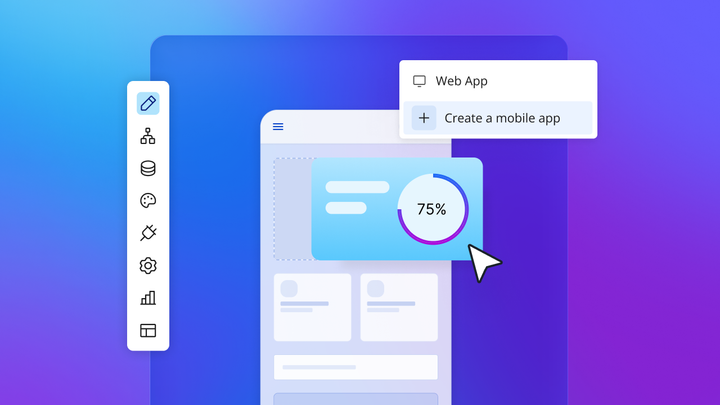
Describe your app to Bubble AI, and it generates the foundation of your app, including the pages, the workflows, and the database, so you can test it immediately. From there, the Bubble AI Agent (beta) is your build partner. It can tweak the UI, adjust data types, build API calls, and add plugins, explaining what it’s doing along the way.
Because every workflow and data relationship lives in the visual editor, your team always sees exactly how the app works. You can change anything by hand without ever touching a line of generated code, which makes development much faster and much cheaper.
Enterprise teams at Unity, Paramount, Yamaha, L’Oréal, Danone, and Seagate already build on Bubble, and Bubble’s 2025 Enterprise Survey found that customers save $300,000 to $1 million a year over custom development while shipping up to nine times faster.
Bubble builds for web and native iOS and Android from one platform with a shared backend. Plug into outside AI services like OpenAI through the API Connector, and you can drop chatbots, content generation, or real-time data analysis right into a production app.
Bubble’s job is turning ideas into real apps people actually use. They’re all built, secured, and deployed without leaving the editor. If your team also needs heavier ML or RAG infrastructure, pair Bubble with one of the infrastructure-first platforms covered earlier in this guide.
Best for:
- Enterprise innovation teams, product managers, and builders who want to generate production-ready internal tools or customer-facing apps quickly, then keep full visual control over how the app works.
- Organizations that want to build for web and native iOS and Android from a single platform with a shared backend. Native mobile is currently in public beta (see what’s included).
- Teams that need SOC 2 Type II compliance, SSO, and visual privacy rules without assembling them from separate vendors.
- Dev teams integrating AI features (chatbots, content generation, data analysis) into production applications via API connectors.
Limitations:
Bubble isn’t a model-training or managed RAG infrastructure platform. If your team has complex custom ML needs, you’ll want a separate AI infrastructure layer alongside it. Native mobile is also in public beta, so check what’s included before committing.
Pricing:
Free plan available for building and testing. Paid annual plans start at $29/month for web only, $42/month for mobile only, and $59/month for web and mobile. Growth, Team, and Enterprise tiers are available, with Enterprise offering custom infrastructure, advanced security, scalability, centralized management, dedicated support, and hosting-location flexibility.
How do these enterprise AI platforms compare?
This table compares the seven platforms on four criteria that most directly shape platform selection: what each is built to do, where it runs, what governance it includes out of the box, and whether it includes an application layer.
| Use case | Deployment | Governance | App layer | |
|---|---|---|---|---|
| Microsoft Foundry | Infra + apps on Azure | Azure cloud | Entra ID Defender Purview Azure Monitor |
❌ |
| AWS Bedrock | Infra + managed agents | AWS cloud with PrivateLink to VPC | IAM KMS CloudTrail |
❌ |
| Gemini Enterprise Agent Platform |
Infra + BigQuery apps | GCP cloud | GCP-native controls | ❌ |
| Databricks Mosaic AI | Custom models, lakehouse data | Multi-cloud | Unity Catalog permissions Lineage Audit logs |
❌ |
| IBM watsonx | Hybrid/on-prem governance | IBM Cloud, AWS, on-premises | Model evaluation and lifecycle tracking | ❌ |
| Vellum | Prompt mgmt + evals | Vellum Cloud; confirm any self-hosted options with Vellum | Observability and versioning | ❌ |
| Bubble | Visual app builder | Managed hosting | SOC 2 Type II Visual privacy rules Security dashboard |
✅ |
For a full breakdown of model support, RAG capabilities, mobile options, and speed to production, see each platform’s section above.
These trade-offs, not vendor marketing, are what should drive your choice.
Which enterprise AI platform fits your team?
Which platform is right for you comes down to where your data lives, what you’re building, and how much infrastructure you want to own. Here’s how each scenario points you in a different direction.
If your stack is primarily Microsoft Azure: Microsoft Foundry plugs directly into your existing infrastructure, data, and identity systems.
If your stack is primarily AWS: Amazon Bedrock keeps model inference inside your VPC through PrivateLink and comes with a managed agent framework, plus AWS-native access controls and encryption.
If your stack is primarily Google Cloud or your data lives in BigQuery: Gemini Enterprise Agent Platform connects natively and gives you access to Gemini and open-source models within GCP.
If your source of truth is in Databricks or Delta Lake: Databricks Mosaic AI plugs into your governed data and lets you fine-tune models on proprietary datasets that generic models can’t handle.
If you’re in a regulated industry and need hybrid or on-premises deployment: IBM watsonx is built for exactly that, with governance tooling plus hybrid and on-premises options.
If you’re running LLMs in production and need better evals, prompt versioning, and cost controls: Vellum handles that layer without making you switch infrastructure or rewrite your application code.
If your goal is shipping AI-powered tools to real users without assembling a custom infrastructure stack: Bubble gets you there fastest. Generate your app with Bubble AI, then use the Agent and visual editor to shape and secure it, and ship it through visual workflows instead of code you can’t maintain.
Many enterprise teams combine platforms rather than choosing just one. A common pattern is using Databricks or Bedrock for the AI and data layer alongside Bubble for the application layer.
Start building with the right enterprise AI platform
The right platform comes down to where your data lives, what you’re building, and how much infrastructure you want to own. Infrastructure-first platforms give you control at the model and data layer, while Vellum handles AI-layer tooling in between.
If your goal is shipping AI-powered apps to real users quickly, Bubble makes that possible, and you don’t have to trade away security to get there. Bubble AI and the Bubble AI Agent get you moving fast, while SOC 2 Type II compliance, SSO, and enterprise-grade infrastructure come standard, so you launch real apps, not prototypes, with real protection built in. Get started for free and see what your team can build.
Frequently asked questions about enterprise AI platforms
What counts as an enterprise AI platform vs. a copilot or SDK?
An enterprise AI platform gives you one centralized control plane for data access, governance, model orchestration, audit logging, and deployment, built to support multiple teams at once, unlike a copilot (which only assists inside a single product) or a raw SDK (which leaves you to build governance and security yourself). People sometimes use “enterprise AI operating system” to mean the same thing, though it usually implies deeper integration across a company’s full tech stack.
What are the main enterprise AI platforms available in 2026?
The main infrastructure-first platforms are Microsoft Foundry (formerly Azure AI Foundry), AWS Bedrock, Gemini Enterprise Agent Platform (formerly Vertex AI), Databricks Mosaic AI, and IBM watsonx. For AI-layer tooling, Vellum handles prompt management, evaluations, and workflow orchestration. And for application delivery, where AI-powered features actually reach users, Bubble gives you a fully visual AI app builder with enterprise security controls built in.
What is Google’s enterprise AI platform?
Google’s enterprise AI platform is Gemini Enterprise Agent Platform, formerly Vertex AI. It gives you access to Gemini models, open-source models via Model Garden, and tools for RAG, fine-tuning, and agent creation, plus native integration with BigQuery and other GCP services. See the section above for the full breakdown of capabilities, best-fit scenarios, and limitations.
How much does an enterprise AI platform cost?
Enterprise AI platform pricing usually comes down to two models: You either pay for what you use, like per-token inference plus usage fees for things like vector databases and agents, or you sign an enterprise agreement upfront with committed-use contracts and dedicated capacity. Microsoft Foundry, AWS Bedrock, and Gemini Enterprise Agent Platform are consumption-based, while Databricks and IBM watsonx offer pay-as-you-go alongside enterprise agreements. Vellum has a free starting option plus custom paid plans, and Bubble has a free plan for building and testing plus subscription tiers by project and platform, with usage-based pricing at scale.
Can we deploy in our VPC with private networking and data residency?
Several platforms support VPC deployment: AWS Bedrock uses PrivateLink to keep inference inside your VPC, IBM watsonx supports on-premises and hybrid deployment, and Google Cloud and Databricks offer region-based cloud deployment. For Microsoft Foundry, check current Microsoft documentation for private networking and private endpoint options. Before you commit, confirm VPC connectivity, private endpoints, BYOK (bring your own key encryption), and region isolation with each vendor during your security review.
Build for as long as you want on the Free plan. Only upgrade when you're ready to launch.
Join Bubble