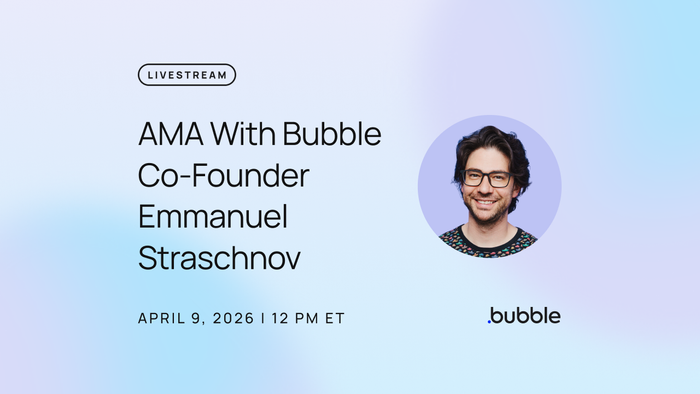

Earlier this week, Emmanuel hosted our third monthly Ask Me Anything session to kick off 2026. He opened by explaining how Bubble thinks about shipping new features — why we release things in beta, how we gather feedback, and what users can expect from the process. From there, he announced the new Bubble podcast, shared updates on AI and mobile development, and answered questions about where the platform is headed this year. Below you can watch the full AMA or read a summary of the key topics discussed.
How Bubble thinks about beta releases
Emmanuel opened the AMA by addressing a question that came up often in December: why Bubble sometimes releases features—like the new property editor—while they’re still evolving.
He started by acknowledging the role of power users and beta testers. “The feedback we get from early testers is incredibly valuable,” he said. “It helps us catch issues early and push the product forward.”
At the same time, Emmanuel explained that beta testers often represent a specific set of advanced workflows. “They tend to use Bubble in very deep ways, which is great—but it’s not the only way Bubble is used,” he noted. He pointed to two other groups the team needs to account for: founders building businesses who aren’t active in the community, and new users who experience the property editor simply as ‘how Bubble works.’
The goal isn’t to ship something broken—it’s to combine expert feedback with real-world usage across a broader set of users, so the team can prioritize the right fixes. “We need to see how different people actually interact with these changes,” Emmanuel said.
Functionality always comes first. “The last thing we want is for anyone—especially our most experienced users—to be less productive,” he added. That’s why users can opt out if needed, and opt back in over time as improvements roll out.
Announcing The New Build, a new podcast by Bubble
Bubble is launching a podcast this month, hosted by Emmanuel and video producer Abhinav.
The focus won’t be on Bubble as a product. Instead, the show will feature founders sharing their stories and how they’re scaling their businesses online. “We want them to share stories to create both knowledge and inspiration for a lot of other people that are thinking about starting business online,” Emmanuel said.
Most guests will be Bubble users, but the goal is broader: helping entrepreneurs learn from people who are a little further along in their journey. “[Hearing from other entrepreneurs] teaches me a lot of lessons and hopefully prevents me from making some mistakes,” Emmanuel said of why he has always personally valued the kind of learnings the podcast aims to provide.
Questions about AI
What new AI features are coming?
The AI Agent is getting weekly updates. Since the October launch, the team has shipped:
- UI element creation and modification
- Dynamic expression editing
- Data type creation (released last week)
- Front-end workflow generation (going live "any day")
Initial app generation, which was previously web-only, now works for mobile apps too.
“The theme for us for the next three or four months is ensuring everything that can be done traditionally — with a mouse and a keyboard in our editor through clicks — should be done in natural language,” Emmanuel said.
Is it normal to prefer Bubble without AI?
“I think it’s totally fine," Emmanuel said. Some experienced users are faster building manually, which isn’t surprising — once you know where to click, things can move extremely fast.
That said, AI will continue improving. “Our job is to make it better at automating a few tasks. And so I still think you will end up eventually saving time with some AI. But it’s really up to you.”
Can the Bubble Agent write custom code?
Not today, but Emmanuel doesn’t see why it wouldn’t eventually. “It’s honestly not very high on the list because there are many other things,” he said. The priority is enabling the Agent to do anything you can currently do manually. But since underlying LLMs already know how to generate code, “it’s probably something [that wouldn’t be very] hard for us to do.”
Are there plans to integrate AI providers directly into Bubble?
Some vibe coding platforms let you connect to AI services with one click rather than setting up API calls yourself. Emmanuel confirmed this is something the team discusses. “I would love to go there because I think it's a better experience for everyone. But we need a little bit of time and it’s not the first thing on the list right now.”
Questions about mobile development
When will in-app purchases be available?
Early February — specifically, the first week. “Very excited about this one,” Emmanuel said. For context, in-app purchases let native app builders use Apple’s and Google’s payment SDKs for subscriptions and purchases, which is a requirement for many consumer apps.
What about mobile plugins?
Emmanuel acknowledged that plugin availability is a current limitation. “Plugins are definitely something that’s important and that we’re actively working on right now." But the team is focusing on getting in-app purchases out the door first.
On the fact that many mobile plugins cost money to use: “Mobile development is more expensive than web development in the world. If you’re looking for a mobile engineer, it’s going to be harder to find them than a web engineer.”
Could AI translate a web app into a native app (or vice versa)?
“Yes, that’s definitely the type of thing we’re talking about [the AI Agent eventually being able to do].” It’s not the immediate priority — the Agent needs to first cover everything you can do manually — but Emmanuel sees clear value: “If someone wants a native mobile app and they’ve already built a web app, if we can come up with the first draft of that first version in a couple of minutes, why not?”
Questions about pricing and workload units
How is Bubble making apps more cost efficient?
Emmanuel emphasized that a large portion of Bubble’s engineering resources go toward platform optimization. “A lot of what they do is ensuring that we do things efficiently. And usually what happens when we do things efficiently on the backend is that [everything’s] more scalable, but it also gets cheaper for people because we just don’t waste resources.”
He was clear about the company's incentives when it comes to usage-based pricing: “We’re not trying to make money when people make mistakes in the way they build their application. We’re trying to make money when they’re really scaling and having success.”
No pricing changes are currently planned, but the team continuously monitors the market.
Can workload units roll over month to month?
Not currently, and there are no active plans to change that. “It’s usually not how things work when you pay, basically, for an allotted usage,"" Emmanuel said. Some services offer rollovers at a premium, but it’s not necessarily more economical. The team is monitoring for opportunities, but nothing is planned.
Will there be regional pricing for countries with lower purchasing power?
Not yet. “The challenge is that our entire business is US-based,” Emmanuel explained. Bubble’s employees are paid US salaries and all our overhead and operational expenses are in US dollars at US costs.
He noted that even much larger companies like Zapier don’t localize pricing yet — it typically requires local support teams and careful implementation to prevent abuse. “It’s something we’re thinking about [for someday]. But frankly, when I look at our peers and the cost and all the infrastructure we would have to do to do that cleanly, it’s something that would take a lot of work and we can’t really do today.”
Questions about platform and infrastructure
What about code ownership and vendor lock-in?
Emmanuel acknowledged this question has resurfaced with the rise of vibe coding. His response: lock-in exists everywhere.
“If your backend is running on Firebase with Google, you’re going to be locked in with Firebase from Google,” he said. “This idea that code prevents you from being locked in is not entirely true."
For Bubble specifically, the commitment is stability. The platform team — nearly half of Bubble’s engineering resources — focuses on ensuring applications can scale and don’t need to move off-platform. And the company's longstanding promise remains: If something ever happens to the business, Bubble will release its source code so applications can continue running.
Are there plans for hosting outside the US without an Enterprise plan?
Someday, but it’s a major project. "Bubble is a complicated system. It’s not like you just have one server and that’s it. We have the web server, the database, caching. We have a lot of things going on and everything needs to be moved at the same time.”
Emmanuel confirmed that some work toward this eventual goal will happen in 2026, though he wouldn’t commit to a specific timeline. In the meantime, he encouraged anyone with data residency requirements to reach out to the sales team — custom configurations may be possible even outside a full Enterprise plan.
What about improving page load speeds and server-side processing?
Speed optimization is ongoing work, not a one-time project. “That’s one of the key KPIs the platform team is looking at every day,” Emmanuel said.
On server-side rendering specifically: “We’ve talked a lot about that over the years, trying to figure out when is the right time. I’m not going to commit on anything here.” It’s being discussed but isn’t where the team sees the highest leverage compared to other platform work.
Are there plans to improve nested searches and joins?
Yes, this is something the platform team actively monitors. “They’re going to look at a dashboard where they see latencies when it comes to database queries. And if they see some queries being slow, they’re going to look at why that happens.”
Optimization work happens continuously, though Emmanuel couldn’t speak to specific use cases without more detail.
Questions about enterprise and compliance
Is HIPAA compliance coming?
Yes, and hopefully not too far in the future. “That’s something we’re actually very actively thinking about,” Emmanuel said. It's a major undertaking — “we take security and compliance seriously, and being HIPAA compliant and doing it in a clean way is a major piece of work" — but the team is working on it.
HIPAA will be an enterprise feature. Emmanuel encouraged anyone interested to reach out to the sales team for updates.
Questions about learning and professional development
What's your recommendation for professional web developers to be most successful?
Two things: learn the platform, and learn product thinking.
On platform expertise: “It’s tempting to just throw yourself in the platform and start building something. And it feels cool at first, especially now with AI.” But investing a few hours in learning will differentiate you when it comes to product quality. “We [often see that] when people start having issues with their applications, it’s usually because they paid someone [to build it] that was not particularly good.”
On product thinking: Consider questions like, “How should I structure an application to make sure it makes sense for the user, that it's easy to maintain? How many pages is a good number of pages?” These questions aren’t Bubble-specific — you’d face them in any development environment. So it pays to invest some time into learning about product development and product thinking, too.
Questions about Bubble’s direction
Why focus on AI when there are bugs and long-awaited features?
Emmanuel was direct: “We are working on bugs.” The team has dedicated triage resources and is forming an editor quality team.
But the question of why not pause AI work entirely comes down to market relevance. “When people who didn’t know about us before start using Bubble today, they expect to have this natural language experience where you can start typing and conversing with a piece of software that’s going to start doing things for you. And if we don’t have that, people will not even engage with our product.”
He framed the stakes clearly: “If we don’t invest in AI, we will not be relevant. And ultimately, everybody in the Bubble community has a very high vested interest in Bubble being around for a long time.”
What would you say to former Bubble Developers who left for alternatives like Claude Code?
“We miss you — and we think you will come back.”
Emmanuel’s view is that visual development is the future. “If you’re a web application, the fact that you have to deal with ‘if then else’ is not right. You should have a layer to do that, a visual abstraction. That’s precisely what Bubble is."
He acknowledged that Bubble is currently behind on AI-powered code generation compared to tools like Claude Code. “I can see why people would do that. But I do think something like Bubble, like a visual language, is the future versus code.”
Does Bubble actually use Bubble?
Yes, extensively. Bubble.io itself is a Bubble app, built by a team of about five internal Bubble Developers. Other examples: The success team uses Bubble-built tools for gathering feedback and managing a CRM. The strategic accounts team built their own CRM for enterprise client workflows and application auditing.
Emmanuel noted a challenge: “Engineers building the product are not the ones using the product naturally because they’re in code.” To address this, the company runs regular internal Bubble hackathons, and every new hire builds an application on Bubble as part of onboarding.
Rapid-fire answers
Will the property editor opt-in be permanent? No — eventually it will be the default experience for everyone. Emmanuel encouraged users to opt in periodically to get comfortable with changes and provide feedback.
Is it possible to see real-time workload unit usage when testing? The best way to do that right now is to look at server logs, which show consumption for each action. But Emmanuel cautioned against optimizing too early: “Focus on the experience, making sure that you have something that works well, and then focus on cost.”
Are there plans to improve Flexbox properties for the responsive engine? Not actively being worked on and hasn’t surfaced as a major limitation. If it’s important to you, submit feedback through the ideaboard.
Are there plans to incorporate AI into the help docs? Emmanuel found the idea interesting and will surface it to the team. In the meantime, LLMs like ChatGPT already know a lot about Bubble.
Thanks for joining us for the January AMA. We’ll see you next month — and don’t forget to subscribe to The New Build podcast on YouTube, Spotify, or Apple Podcasts!
Build for as long as you want on the Free plan. Only upgrade when you're ready to launch.
Join Bubble