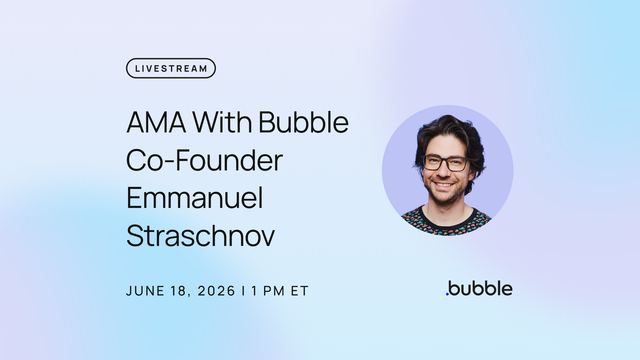
Every month, Bubble co-founder Emmanuel Straschnov opens the floor to the community for a live AMA on YouTube, answering questions that span platform philosophy, product updates, and practical advice. The June session had a bit of an extra charge to it: Before taking a single question, Emmanuel shared a live demo of something the team is about to ship.
What followed was a wide-ranging conversation covering the AI Agent rollout, what Bubble's approach to visual programming means in a world full of new vibe coding tools, app security, platform commitments, and more.
A redesigned data tab is almost here
One of the highlights of June's AMA wasn't a question at all: It was a live demo. Before moving to the Q&A, Emmanuel walked viewers through the redesigned data tab that's arriving in beta by the end of the month. If you want to watch it, it’s the first thing Emmanuel covered in the video above.
The team has been gradually modernizing different areas of the editor, and the data tab is finally getting its turn. The new experience brings a modern grid layout, cleaner filter controls, more intuitive field selection, and the ability to save named views. Inline editing arrives as part of this too, letting users modify records directly from the tab with a click rather than navigating elsewhere.
AI-assisted dummy data generation, already part of the data tab but previously less discoverable, is surfaced more cleanly in the redesigned layout as well. The team is actively looking for feedback once beta goes live, and the sooner users share reactions, the faster the team can iterate.
The AI Agent: What's shipped and what's coming
The Bubble AI Agent landed a significant new capability in the weeks before the June AMA: compound editing, AKA the ability to make multiple changes to an app simultaneously in the right order. Emmanuel called it "a huge feature," explaining that it reflects a more sophisticated approach to complex tasks. The Agent can now understand what needs to happen across different parts of an app and execute those changes together, rather than one at a time.
On the rollout front, the Agent is currently available to Bubble Ambassadors and Gold agency partners. July is the next expansion milestone, with the goal being broad availability well ahead of Q4. "It's not that we don't want to give access to everyone — I do," Emmanuel said. "It's just that we want to make sure this works well." The staged rollout is specifically about ensuring the Agent handles larger, longer-established apps reliably.
Looking further ahead, plugin suggestions — the ability for the Agent to recommend or add a plugin when a feature requires one — are on the roadmap. Emmanuel estimated that could arrive within "the next few weeks or a couple of months." For anyone following ongoing progress, he pointed to bubble.io/release-notes as the most detailed resource for what's shipping week to week.
Visual programming in a world of vibe coding tools
A community question comparing Bubble to tools like Lovable, Base44, and Replit gave Emmanuel a chance to articulate what actually distinguishes the platform, and he offered two clear answers.
The first is the language Bubble uses. Other tools generate code; Bubble uses visual, workflow-based descriptions of how an app should behave. "I'm very convinced that code is not the right medium to describe applications," Emmanuel said. A workflow that reads "when this button is clicked, send an email, change the page" is simply more legible than the equivalent in code, and that remains true even as AI makes writing code easier. "Even though AI has admittedly made creating code easier, I still think visual programming is the right way to build applications. We just need AI to be as good as it is with visual languages as it is with code."
The second difference is what kind of platform Bubble is. Most vibe coding tools generate code that still needs to be hosted and maintained elsewhere. Bubble handles all of that, and has done so in production for 14 years. Emmanuel used the example of an app going viral at 4 AM: "With most of those vibe coding tools, you're gonna have to figure that yourself." Bubble, by contrast, has built-in infrastructure and a dedicated DevOps function. Bubble is built for production, not just prototyping.
What the AI era means for Bubble agencies
A community member worried about agencies losing ground as AI makes app creation more accessible prompted a direct response. Emmanuel's take: It's a harder environment for agencies, but not a smaller one.
As AI enables more people to start building Bubble apps on their own, the total addressable market for agencies grows. More apps in the world means more potential clients. That raises the bar for the value agencies offer. Clients can do more on their own now, so the work of justifying a partnership has to come from deeper expertise. "Get good at the Bubble fundamentals," Emmanuel said. "AI is great, but it's not necessarily always the best thing." It does what it's told; it doesn't always take initiative or make smart architectural choices. A skilled human who can catch what the AI misses and push an app further than the Agent would think to take it still matters.
Security is not optional
An open-ended question about how to make a Bubble app more secure gave Emmanuel a moment to address something he thinks is genuinely underappreciated, especially now that building apps is getting faster and easier.
"With the emergence of platforms that let you create applications in an easier and easier manner, sometimes you have the excitement of creating an application... but then you don't necessarily think about security until you have real users." He pointed to two common risk areas: privacy rules, which control who can access what data, and exposed API keys. His practical recommendation is to use Bubble's security dashboard.
"If you have an application that is live with actual users and you haven't used the security dashboard, you should stop everything you're doing and go there." The security dashboard is accessible from within the editor and walks users through a structured audit of common vulnerabilities. It's been available for about two years and remains one of the most direct paths to understanding whether an app is properly locked down.
Source code, regional infrastructure, and the long-term platform commitment
Emmanuel reaffirmed a commitment Bubble has held for over a decade: If the company were ever to shut down, Bubble's source code would be released so that existing applications could continue to run. "I'm very happy to make that commitment again," he said.
On the related question of code export for individual apps, Emmanuel was candid about where things stand. Bubble apps aren't generated as editable code; they're described in structured .bubble files that Bubble's shared runtime executes, so there's nothing today that can be handed off as an exportable source. "I would love to do that. I think it would be a great addition to our product," he said, acknowledging it's not the current priority given everything else on the roadmap.
On regional infrastructure, Brazil came up. It's Bubble's second-largest market globally, and questions about local data hosting have become more pressing as data sovereignty concerns grow worldwide. Emmanuel noted that the team is doing foundational work now that will eventually enable dedicated regional services, building toward something similar to what's in progress for Europe. Brazil is named as a clear next consideration once Europe is further along.
What's on the roadmap
A few other topics surfaced shorter but useful updates.
Workflow branching is in active development, but it requires meaningful changes to the underlying workflow engine that handles execution at scale in production. Still, the team is working on it.
He also acknowledged that the server logs UI is a gap. The team is actively working on improvements to both the infrastructure and the editor-facing experience, with search, filtering, and usability all getting attention.
A community member (who manages 170 backend workflows!) requested a way to search between them. Emmanuel agreed that was something we should have and committed to surfacing it to the team.
Last but not least, the plugin editor continues to receive investment, particularly in response to more users building their own plugins through AI-generated code. The plugin marketplace, by contrast, is lower on the priority list as that shift plays out.
Full question list with timestamps
0:03 — Data tab redesign demo (opening)
3:53 — What's Bubble shipping with AI to close the front-end speed gap?
3:53 — What's the tech stack for Bubble apps built for Shopify?
5:52 — If clients can use AI to build their own apps without technical skills, how can agencies still bring value?
7:50 — When will Bubble give users access to their app's source code to export and version in GitHub?
9:42 — Since Brazil is Bubble's number two market, are there plans for dedicated regional infrastructure there?
11:34 — How do I get my app featured on the Bubble is Global map?
11:34 — Is it possible to receive emails about which Bubble updates may affect my app?
13:38 — Can you add search for backend workflows?
17:45 — Can the plugin marketplace be made searchable by full description, not just title?
17:45 — Sign in with Outlook, Microsoft, and Google works on web but not on native — is that on the roadmap?
19:49 — Do you have plans to minimize JavaScript code for page load?
19:49 — Can the selection of which backend workflow to call be made dynamic rather than a fixed list?
21:57 — Can we have a standalone version of the database tab?
22:46 — I've done everything I can to improve Google Web Vitals except the performance score — any advice?
23:47 — Could Bubble AI suggest relevant plugins when a feature needs one?
24:25 — When did you prioritize marketing?
26:17 — What can we expect from the Bubble AI Agent compared to others on the market, and when will it be available to everyone?
27:50 — Any plans to compress user-uploaded data to save storage space, the way cloud storage services do?
29:26 — I'm building a health tech dashboard and struggling to upload data per clinic facility — any guidance?
30:30 — We need the ability to store and access application logs.
31:53 — When is the AI Agent coming to all apps?
33:32 — When can we expect updates to the features you showcased in the recent livestream?
33:32 — How can I make my app more secure?
36:40 — Any plans to add folders for elements or backend workflows?
37:41 — Are there plans to improve the server logs UI/UX?
37:41 — Data tab redesign demo (re-run for late arrivals)
40:35 — Can parameters in global expressions be made optional?
40:35 — Do you have plans for cheaper Bubble plans in South Asian and African regions?
42:46 — When will Bubble support server-side rendering for page load?
43:18 — What's the key difference between Bubble and Lovable, Base44, and Replit?
Build for as long as you want on the Free plan. Only upgrade when you're ready to launch.
Join Bubble