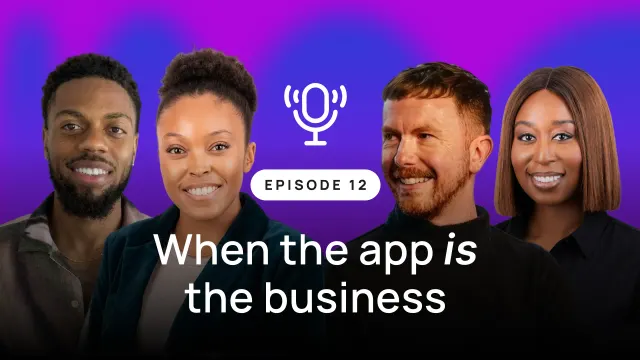
When Julian started Clover Dogs with his cofounders, finding a rescue dog meant scrolling through what felt like Craigslist from 2009. When Andrew built Land, he'd just watched the sky over Midtown turn orange from Quebec wildfires — nobody in the office knowing whether to go outside or where to turn — and realized there was no app that could help. When Obi and Onyi built MMARA, the medical research to help women understand their own hair loss barely existed.
In the Season 1 finale of The New Build, Abhinav talks with all three about how they saw those gaps, and why they each decided the phone was the right place to fill them.
About Clover Dogs
Clover Dogs is a mobile-only dog adoption app that replaces the directory-style listings of platforms like Craigslist or Petfinder with curated dog profiles, swipe-based discovery, and real-time chat between prospective adopters and the shelters behind each listing. AI agents pull dog listings automatically from rescue websites and keep profiles updated, cutting the manual work that previously consumed hours of shelter staff time. Map functionality is already built into the app, with fostering features and a 24/7 rescue reporting tool in development.
About Julian
Julian is the co-founder and CEO of Clover Dogs, a mobile app that uses dating-app swipe mechanics to connect people with rescue dogs available for adoption. He built the company alongside his wife and co-founder Alexis, who brings a background in animal rescue, and two additional co-founders, Lucas and Emily. Julian and Alexis met on Hinge — that connection-through-profile logic is exactly what they built Clover Dogs around.
About Land
Land is a data-driven mobile app — and it’s not a weather app. Weather apps tell you what's coming today or this week. Land works on a longer scale, drawing on a proprietary storm events database spanning more than 30 years (some hazards tracked back to the 1950s) to show how risks are shifting over time for a specific location. The app translates that into daily reads written in plain language and generates personalized supply kit recommendations for users to track and act on. Its guiding motto: "acts, not fear."
About Andrew
Andrew Haarsager is the solo founder of Land, a personal climate resilience app built to help people understand their long-term exposure to climate-driven hazards and prepare accordingly. Before Land, he spent seven years as the founding Head of the Retail Innovation Lab at Cartier North America, designing experimental in-store experiences. He's been building on Bubble with no prior coding background and has rebuilt the app twice based on what users told him.
About MMARA
MMARA is a women's hair-health tracking app that uses daily logging — progress photos, scalp observations, lifestyle habits, diet, and symptoms — to build a longitudinal dataset around hair loss. Hair loss often surfaces before other conditions are formally diagnosed; MMARA is built to track the patterns across those data points so users and their doctors can see what a single appointment rarely reveals. The app is live on iOS and Android and was recently rebuilt with a sharper focus on daily logging. A personalized insights feature is in development, powered by AI the team is building in-house — a deliberate choice, given how poorly general-purpose models perform on women's health questions.
Try it: themmara.com ∙iOS
About Obi and Onyi
Obi Chukwuma is co-founder and Chief Growth Officer of MMARA. Onyi Chukwuma is co-founder and COO. Both are based in the New York metro area. They co-founded MMARA alongside Crystal Chukwuma, the company's CEO and a full-time marketing executive whose experience shapes MMARA's brand strategy. What began in 2020 as a hair products website became — after years of customer interviews and one major pivot — a mobile health tracking app. All three co-founders personally experienced hair loss and were frustrated by how little medical research existed to help them understand why.
What you'll learn in this episode
This Season 1 finale brings three conversations into one episode, each with a founder who built mobile-first and found something different waiting. Julian walks through how the dating-app model changed the experience for shelters and adopters alike, and why going mobile-only actually reduced the operational burden on rescue organizations. Andrew explains what separates climate data from weather data, what he learned from a version of the app that looked more like a fitness tracker, and how the astrology industry ended up being his most useful design reference. Obi and Onyi share the longest arc in Season 1 — five years from a hair products website to a health data platform — and why they've chosen to build their AI slowly rather than ship something they can't stand behind.
Episode timestamps
[00:00:00] Introduction: Season 1 finale format — three back-to-back conversations with mobile-first founders
[00:01:14] INTERVIEW 1: Julian on why dog adoption needed a mobile-first experience and what was missing before Clover Dogs
[00:03:19] How mobile created unexpected possibilities: gamification, Clover Chat, and real-time shelter communication
[00:10:50] Hot take: mobile virality only reaches audiences under 22 — a filter for any founder deciding between web and mobile
[00:14:12] INTERVIEW 2: Andrew introduces Land and why it is not a weather app
[00:16:26] The founding moment: watching NYC's sky turn orange from Quebec wildfires in 2023 and realizing no app could help
[00:22:11] The pivot from fitness tracker to horoscope model — why probabilistic risk data needs a different communication frame
[00:34:56] Hot take: founders package their ideas to sound fundable and give up their only differentiation
[00:39:19] INTERVIEW 3: Obi and Onyi on MMARA which didn't start out as a tech company
[00:41:40] How stories of self-diagnosed lupus revealed the health data gap MMARA was built to fill
[00:49:38] ChatGPT gets women's health questions wrong 60% of the time — why clinicians are excited about MMARA
[00:59:25] Obi's playbook: pivot every day and stay obsessed with the problem, not the solution
[01:08:57] Why trust is the real differentiator when AI apps are easy to launch
[01:10:31] Season 1 wrap-up, Bubble product announcements, and Season 2 invitation
Key insights from this episode
Mobile virality is audience-specific
People often assume that mobile apps can help a company grow virally, but Julian's view is that virality is audience-dependent, and founders often miss this. After around age 22, the number of people you naturally talk to or share things with in a day drops off sharply. If you're building a mobile app that needs social spread and you're not targeting a younger audience, you're working against the medium. Clover Dogs benefits from the inverse: Its swipe-and-discover mechanic maps directly onto how its audience already uses their phones, and users have been found streaming the app to their TV and swiping through dogs with a roomful of friends. That kind of organic spread comes from knowing exactly who the app is for.
Your authentic voice as a solo builder is an asset you can lose
Andrew of Land watched founders take genuinely original ideas and package them to sound like whatever's currently being funded — and in doing so, give up the one differentiation they had. His advice is to start with the specific, creative voice you have before you have a board of directors to answer to, because "you can always dumb things down later, but it's very hard to go from a kind of mass voice to something more creative." Reach for the audience that didn't know they were looking for you. That audience is much harder to find after you've already softened what you built to find them.
When it's easy to launch an AI app, trust is what's hard to copy
Obi says that in a landscape where launching an AI-powered product has become trivially easy, user trust is the actual differentiator. It’s also one that takes real time to build. MMARA has deliberately chosen not to build on top of general-purpose AI models for health guidance, even though it would be faster, because those models get women's health inquiries wrong at a significant rate. Building their own AI is slower and riskier. It's also what makes the product credible to the clinicians, autoimmune associations, and prenatal communities they're partnering with, and what separates it from the apps that will be easier to launch and easier to dismiss.
For all three, mobile shaped what each product could be
All three conversations arrive at the same place: The smartphone was a design requirement. For Clover Dogs, the swipe mechanic that drives discovery only works as a native mobile experience, and the real-time chat between adopters and shelters depends on the immediacy a phone provides. For Land, the connection between climate risk data and physical preparation requires portability; you can't leave a laptop behind when you're evacuating. For MMARA, the daily logging that generates meaningful health data over time depends on habitual, low-friction access that only a phone makes natural. In each case, building for mobile wasn't about where users happen to be. It determined what the product could do.
Resources
- Bubble Launch Lab — Bubble's program for spotlighting builders; all three companies in this episode are Launch Lab participants
- App Gallery — Bubble's revamped app discovery page, now featuring app profiles and upvote leaderboards
- Launch Kit — Free beta tool that generates a marketing and brand kit from your live app: social copy, email copy, and 9 image variants
- Plugin marketplace — 550+ mobile plugins available; the mobile plugin editor is now in alpha
Listen and subscribe
The New Build is a bi-weekly podcast exploring how solo founders and small teams are building products that reach millions of users. New episodes drop every other week.
Subscribe: YouTube · Spotify · Apple Podcasts
Build for as long as you want on the Free plan. Only upgrade when you're ready to launch.
Join Bubble