TL;DR: Cross-platform mobile development lets you build once and deploy to both iOS and Android. Leading frameworks like React Native, Flutter, and Kotlin Multiplatform take different approaches with different trade-offs. The right choice depends on your team’s existing skills, your app’s performance needs, and how much long-term complexity you’re willing to own.
Building a mobile app means making an early decision: Build separately for iOS and Android, or find a shared path that covers both. Separate native builds give you full platform control, but they also mean different codebases, different tooling, and often different teams — just to ship the same core product on two platforms.
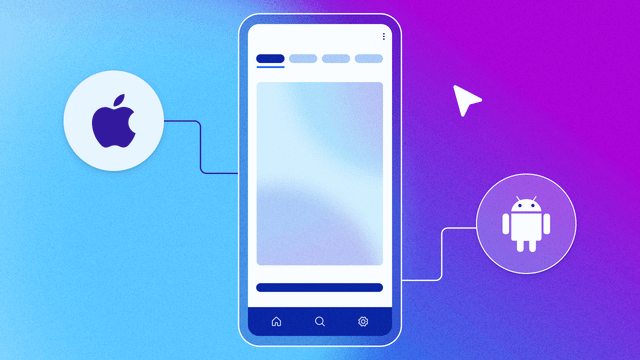
Cross-platform mobile app development gives you a more practical path: Build once and deploy across iOS and Android, with strong performance, faster iteration, and far less overhead than maintaining two separate native builds.
Below, we break down how cross-platform development works, compare the main approaches, walk through seven top frameworks and their real trade-offs, and show what it looks like to build for iOS and Android without writing framework code.
What is cross-platform mobile app development?
Cross-platform mobile app development means building a single app that works on both iOS and Android from a shared codebase, rather than maintaining separate builds for each platform. Depending on the framework, the final app may compile to native elements, render its own UI layer, run inside a web view, or share business logic while keeping some platform-specific pieces separate. Each approach carries different trade-offs in performance, flexibility, and development speed.
Cross-platform app development frameworks
When you build cross-platform mobile apps, you usually work with a framework instead of coding directly in a platform-specific language. The distinction matters because it affects how fast you can build, how much you can reuse, and how much platform-specific work still falls on you.
Native mobile teams often use Swift or SwiftUI for iOS and Kotlin for Android. These languages aren’t exclusively tied to those platforms (Kotlin, for example, also supports multiplatform development), but in native builds, teams typically write directly in them and maintain separate mobile projects.
A framework gives you a structure for building apps across platforms. It often sits on top of one or more languages and includes pre-built components, tooling, and conventions. For example, Bubble for native mobile apps is built on React Native’s architecture and includes ready-to-use interface elements and mobile gestures, which cuts down the amount you need to build from scratch.
Think of the framework as the system that organizes how your app gets built and shipped. Your choice affects more than syntax. It shapes the entire development process.
- Development speed: Frameworks with strong component libraries and built-in testing workflows shorten the path from idea to launch.
- Language requirements: The language your app relies on affects who can maintain it, how steep the learning curve is, and how much custom work your team can realistically handle.
- Ecosystem depth: Rich plugin ecosystems save time. Smaller ecosystems often mean building common features from scratch.
- Customization range: Some frameworks give you broad access to native device features; others make advanced customization significantly harder.
- Iteration speed: Hot reload and similar features make a real difference when you’re testing changes every day.
Different approaches to cross-platform development
Cross-platform development isn’t one thing. The tools and approaches vary significantly — two options can both claim iOS and Android support while producing very different apps through very different means.
These are the main approaches you’ll see:
- Compiled cross-platform frameworks: Tools like React Native and Flutter both let teams build from a shared codebase, but they work differently. React Native relies on native components on each platform, while Flutter compiles to native apps and renders its own widget-based UI. Either approach usually gives you a strong balance of speed, performance, and access to device features for most app teams.
- Hybrid web view wrappers: Tools like Cordova package a web app inside a native shell. This works well for simple projects and web teams that want mobile distribution quickly, but performance and native feel are usually weaker.
- Shared business logic SDKs: Tools like Kotlin Multiplatform let you share data models and business logic while building the interface separately for iOS and Android. This gives you more native control, but also more platform-specific work.
- Progressive web apps (PWAs): PWAs behave like apps in many ways and can live on a user’s home screen, but they still run in a browser. They’re useful for lightweight use cases, but they don’t fully replace native mobile apps when you need deeper device access or app store distribution.
You’ll also hear people use the terms “framework” and “SDK” interchangeably. They overlap, but they’re not identical.
- A framework gives you both the tools and the structure. It helps you build the app and defines how the pieces fit together.
- An SDK gives you the tools, but less of the blueprint. You can often reuse logic and shared components, but your team will usually need to make more architectural decisions and build more by hand.
Native vs. cross-platform mobile app development
Native development means building separately for each platform — typically Swift for iOS, Kotlin for Android — with full access to platform-specific APIs and UI conventions. Cross-platform development trades some of that specificity for a shared codebase that covers both.
Early cross-platform frameworks often produced apps that felt noticeably slower and less responsive than their native counterparts — enough that performance alone could rule them out. That gap has narrowed significantly with modern frameworks.
For most business apps, marketplaces, internal tools, customer portals, SaaS products, and content-driven apps, modern cross-platform frameworks perform well enough that time to market and maintainability carry more weight than theoretical performance differences.
Native still makes sense for some projects — graphics-heavy games, apps with unusually deep hardware integration, or products where every interaction needs to be tuned at the OS level. For most teams, though, the real question is which cross-platform approach gives you enough control without doubling the work.
Top frameworks for cross-platform mobile app development
The best framework depends on your team’s experience, your app’s complexity, and how much trade-off you can tolerate in performance, customization, and speed. These seven options cover the main paths builders consider today.
React Native: Best code-first cross-platform framework for experienced JavaScript teams
React Native is one of the most widely adopted cross-platform frameworks. It gives you a shared development model across iOS and Android while still relying on native mobile components, which helps it deliver strong performance and a familiar mobile feel.
| Pros of React Native | Cons of React Native |
|---|---|
| ✅ Fast development cycles, especially for teams already familiar with JavaScript or React. | ❌ Some features and interface elements still rely on third-party libraries, which can add maintenance overhead. |
| ✅ Hot reloading speeds up testing and iteration, which is especially useful for startups shipping frequent product changes. | ❌ Performance is close to native, but advanced device-specific behavior may still require custom native code. |
| ✅ Strong component ecosystem reduces the amount of platform-specific UI work your team has to do manually. | ❌ Very complex animations and graphics-heavy experiences can still feel less optimized, especially on Android. |
| ✅ Native capabilities are accessible without forcing you to build two separate apps from scratch. | |
| ✅ Large community support means better documentation, more plugins, and more hiring flexibility over time. |
React Native tends to work well for teams that need to build quickly across platforms while keeping the result close to native. It’s especially common with teams that already know React on the web and want to extend that knowledge into mobile.
The main limitation is that React Native still assumes comfort with code, package management, and debugging across a shifting ecosystem. That’s manageable for experienced developers, but it can become a wall for founders or operators who want speed without taking on a JavaScript mobile stack.
Best for:
- Teams that already know React or JavaScript and want one of the most mature cross-platform options.
- Startups that need strong mobile performance without maintaining two separate native apps.
- Founders and operators who want native iOS and Android apps without managing a mobile codebase.
Flutter: Great for OOP builders
Flutter is Google’s cross-platform framework, built on Dart as its programming language. It tends to appeal to developers already comfortable with object-oriented languages like Java or C#, particularly those who want full control over the interface layer.
| Pros of Flutter | Cons of Flutter |
|---|---|
| ✅ Quick development, especially when your team is comfortable working in a widget-based UI system. | ❌ Release management may require extra tooling or app-store releases depending on the type of update; verify OTA requirements against Flutter documentation and app-store rules before deciding. |
| ✅ Well-established and widely trusted, especially for Android-focused teams. | ❌ Flutter renders its own widget-based UI across platforms, so teams should test iOS-specific patterns carefully if the app needs to match Apple platform conventions closely. |
| ✅ Large community and extensive documentation make it easier to learn than less mature alternatives. | ❌ Flutter has a large package ecosystem through pub.dev, but teams should audit the specific native integrations they need before committing. |
| ✅ If you already know object-oriented programming, Flutter’s development model often feels intuitive. | ❌ Dart adds a real learning curve for teams coming from web development or for non-technical builders. |
| ✅ Strong UI control makes Flutter attractive for highly customized app interfaces. |
Flutter tends to suit teams that want a fully controlled, consistent interface across platforms and are comfortable adopting Dart. The trade-off between design consistency and strictly native platform behavior is one most teams will want to evaluate against their own requirements.
Best for:
- Android-leaning teams that want cross-platform coverage without giving up interface control.
- Developers familiar with Java, C#, or other object-oriented languages who can pick up Dart quickly.
- Products where a highly customized UI matters more than matching each platform’s native conventions exactly.
Kotlin Multiplatform: Great for Android-centric development
Kotlin Multiplatform takes a different approach from tools like React Native and Flutter. Instead of sharing the full app stack, it focuses on sharing business logic and data layers while allowing teams to build the iOS and Android interfaces natively. It’s officially supported by Google for sharing business logic between Android and iOS, and is also used across desktop, web, and server-side platforms.
| Pros of Kotlin | Cons of Kotlin |
|---|---|
| ✅ Familiar and efficient for Android teams already working in Kotlin. | ❌ It’s especially familiar to Kotlin/Android teams, so groups without iOS experience may face a learning curve when extending to Apple platforms. |
| ✅ You decide how much code to share, which gives your team more architectural flexibility. | ❌ Some platform-specific features may still require platform-specific implementation, so teams should evaluate library and Jetpack support for the exact platforms and features they need. |
| ✅ Native-like performance is strong, especially on Android, because the shared logic sits close to the platform layer. | ❌ Kotlin Multiplatform is stable and production-ready for sharing business logic between Android and iOS, though tooling and library coverage for some platforms is still evolving. |
| ✅ The modular model works well for teams that want to modernize gradually instead of rewriting everything at once. | ❌ It’s slower to build with than full UI-sharing frameworks, which makes it a weaker choice for fast MVP delivery. |
| ✅ Backed by Kotlin and JetBrains, with official Google support for Android and iOS sharing. |
Kotlin Multiplatform is most useful when your team already has strong Android expertise and wants to reduce duplicate logic across platforms without giving up native interfaces. Teams should evaluate library coverage and tooling maturity against their specific stack before committing.
Best for:
- Android-first teams that already use Kotlin and want to reduce duplicated logic.
- Organizations that want native iOS and Android interfaces while sharing backend logic and data models.
- Projects where long-term architectural control matters more than launch speed.
Ionic: Great for devs familiar with web-based programming languages
Ionic sits closer to the web than React Native or Flutter. It uses HTML, JavaScript, and CSS, and integrates with familiar frameworks such as Angular, Vue, and React. That makes it approachable for web developers who want to extend existing skills into mobile.
| Pros of Ionic | Cons of Ionic |
|---|---|
| ✅ It supports widely used web languages and frameworks, which shortens ramp time for web teams. | ❌ Performance is typically weaker than compiled cross-platform options because Ionic relies heavily on web technologies. |
| ✅ It’s relatively straightforward to learn if your team already builds modern web apps. | ❌ Ionic/Capacitor projects still require platform-specific setup for iOS and Android builds, so review the official setup requirements before choosing it. |
| ✅ Access to many native device features makes it usable for a broad range of business apps. | ❌ Ionic has official documentation, UI components, Capacitor native APIs, and framework packages for Angular, React, Vue, and JavaScript; teams should verify plugin coverage for their specific use case. |
| ✅ Pre-styled components help teams get a polished interface in place quickly. | ❌ Heavily customizing those pre-styled components can become frustrating. |
| ✅ Popular enough to have a meaningful community and long-term viability. |
Ionic makes the most sense when speed and familiarity matter more than maximum performance. If your team already thinks in web components and wants a relatively smooth path into mobile, it can be a practical option.
Best for:
- Web development teams that want to reuse their existing skills and workflows.
- Simple to moderately complex business apps where near-native performance is helpful, but not critical.
- Projects that benefit from pre-styled components and faster initial setup.
NativeScript: Great for experienced JavaScript devs
NativeScript lets JavaScript developers build mobile apps that map closely to native platform APIs and UI elements. It appeals to teams that want more direct native access than a web view model provides, while staying in a JavaScript-centered workflow.
| Pros of NativeScript | Cons of NativeScript |
|---|---|
| ✅ Direct access to native APIs and interface components can produce stronger performance than browser-based approaches. | ❌ Debugging and troubleshooting can be difficult, especially for teams without deep mobile experience. |
| ✅ JavaScript developers can stay in a familiar language while targeting native mobile environments. | ❌ NativeScript offers direct native API access, but teams should audit its plugin marketplace and community support for their required integrations before choosing it. |
| ✅ It offers strong customization for teams that need lower-level control. | ❌ Because team familiarity and available support vary, evaluate NativeScript’s community, hiring pool, and plugin coverage against your project requirements. |
| ✅ It can be a strong option for specialized apps when your team knows exactly what it needs. |
NativeScript has a smaller ecosystem than React Native, which has practical implications: fewer plugins, a smaller hiring pool, and less community support when you run into unexpected behavior.
Best for:
- Experienced JavaScript developers who want direct access to native APIs.
- Teams building specialized apps where custom performance tuning matters.
- Builders who are comfortable trading ecosystem size for lower-level flexibility.
.NET MAUI: Great for those embedded in the Microsoft ecosystem
.NET MAUI is Microsoft’s cross-platform framework built on C#. It’s most compelling for teams that already live inside the Microsoft ecosystem and want to extend existing skills, tooling, and code into mobile development.
| Pros of .NET MAUI | Cons of .NET MAUI |
|---|---|
| ✅ It feels familiar for teams already fluent in C# and Microsoft development workflows. | ❌ It can be cumbersome to debug and harder to learn for teams without C# experience. |
| ✅ Visual Studio integration can simplify development for Microsoft-first organizations. | ❌ .NET MAUI has official Microsoft documentation and tooling support, but teams should evaluate whether its community and ecosystem match their specific needs. |
| ✅ It can help organizations reuse existing .NET knowledge and some shared logic. | ❌ .NET MAUI provides platform-integration APIs, but advanced or highly platform-specific behavior may still require platform-specific implementation. |
| ✅ It’s worth considering when your broader stack is already tied to Microsoft tooling. | ❌ Teams with demanding UX or performance requirements should prototype and benchmark .NET MAUI against their target devices before committing. |
| ❌ It doesn’t solve web and mobile in one place, so many teams still need additional tooling. |
.NET MAUI tends to make the most sense when your team is already invested in Microsoft tooling and C#. Outside that context, its ecosystem is narrower than more widely adopted alternatives.
Best for:
- Organizations already invested in Microsoft tooling and C# development.
- Teams adapting an existing .NET project for mobile use.
- Internal business apps where top-tier mobile performance is less important than stack consistency.
Cordova: Great for very simple apps that don’t need strong performance
Cordova takes a wrapper approach. Instead of compiling your app into native elements, it packages a web app into a mobile container so it can run like a mobile app. That keeps the development model familiar for web teams, but it also creates clearer performance limits.
| Pros of Cordova | Cons of Cordova |
|---|---|
| ✅ Web developers can reuse HTML, CSS, and JavaScript to get a mobile app into app stores quickly. | ❌ Performance is weaker because the app runs inside a web view instead of using native UI components. |
| ✅ It’s approachable for simple projects and lightweight companion apps. | ❌ Native interactions can feel less polished, especially in more demanding mobile experiences. |
| ✅ It can be cost-effective when mobile distribution matters more than mobile sophistication. | ❌ Cordova relies on plugins for many native capabilities, so teams should audit the maintenance status and reliability of the specific plugins they need. |
| ✅ It works well for teams that already have a web app and want basic mobile packaging. | ❌ It’s a poor fit for apps that need strong responsiveness, advanced animations, or deep device integration. |
Cordova works best as a lightweight bridge for projects where mobile distribution matters more than a polished native experience.
Best for:
- Simple web apps that need a basic mobile presence.
- Projects where speed and low effort matter more than native feel.
- Internal or informational apps with modest performance demands.
How to choose a cross-platform development framework
Choosing a framework comes down to what fits your team, timeline, and product constraints — not which option looks best on paper.
1. Experience and expertise
Your team’s existing skill set matters more than framework hype. A strong React team can usually be productive in React Native much faster than in Flutter. A Kotlin-heavy Android team may find Kotlin Multiplatform more maintainable over time, even if it’s slower upfront.
Ecosystem depth matters, too. Large libraries and mature plugin support reduce the amount of custom code you need to write and maintain. Smaller ecosystems can still work, but they often raise long-term cost because your team has to solve more problems alone.
Bubble changes this equation for non-developers and mixed-skill teams. You don’t need to learn a programming language or a mobile framework first. You build visually, which means you can inspect the interface, workflows, data structure, and privacy rules directly instead of hoping generated code is doing the right thing.
2. Knowledge level
If you’re an experienced developer, learning another framework may be manageable. If you’re a founder, product lead, or operator with limited engineering depth, every additional language and tool increases the chance the project stalls when something breaks or needs customization.
AI coding tools can be a fast way to start, but they often leave non-developers with code they can’t read, edit, or maintain when the app needs to change.
Bubble solves that differently: you can start fast with Bubble AI, then switch to direct visual editing when you want precision. When you can see how your app works — the interface, the logic, the data — you can fix it yourself when something breaks.
3. Performance
Performance needs vary by app type. A lightweight internal app or simple customer portal can tolerate more compromise than a mobile-first consumer product where speed, responsiveness, and polish shape retention.
If your app is straightforward and your mobile presence is secondary, a wrapper-based approach like Cordova or a web-leaning option like Ionic may be enough. If performance matters more, React Native and Flutter are worth evaluating. If you need native interfaces with shared logic, Kotlin Multiplatform is worth considering.
Build your cross-platform mobile app on Bubble
After comparing frameworks, the hardest part is often deciding how much code, maintenance, and hidden complexity you want to own.
With one Bubble project, you build for web, iOS, and Android, with a shared database, backend workflows, and privacy rules you can inspect and adjust yourself. For web apps, Bubble AI can generate design, workflows, database structure, and logic. For native mobile, AI generation is in beta and currently covers UI and dynamic expressions, with workflows and data generation still rolling out.
Here’s what that looks like in practice:
- React Native foundation, no React Native code. Bubble’s mobile engine now uses React Native’s architecture, giving you native iOS and Android reach while you build and maintain your app visually — so you can launch real apps without managing React Native code.
- AI generation plus direct visual control. Start with Bubble AI where available, then refine visually when you need precision. On web, the Bubble AI Agent (beta) can help with UI, data types, expressions, and supported frontend workflows; native mobile AI and Agent editing are rolling out in beta.
- Web and native mobile from one project. Your web and mobile apps can share the same backend, database, and backend workflow logic, while you design mobile-specific native views for iOS and Android.
- Security and scale built in from day one. Bubble includes hosting, automatic scaling, privacy rules, SOC 2 Type II compliance, and an integrated security dashboard with checks for privacy rules, exposed tokens, and leaked secrets, while Flusk adds deeper security visibility for teams that need it.
Bubble also isn’t the right fit for every mobile project. If you’re building a graphics-heavy game or an app that depends on unusually deep operating-system control, a dedicated native stack may still make more sense. For most business apps, marketplaces, SaaS products, internal tools, and customer-facing mobile experiences, Bubble gives you AI-powered speed with visual control — so you can launch real apps, understand how they work, and keep iterating without getting stuck in code.
Build for free until you’re ready to launch →
Frequently asked questions about cross-platform mobile app development
What is the best cross-platform mobile development framework?
React Native is the strongest overall choice for most teams — it combines a large ecosystem, strong performance, and faster development than fully native builds, especially for teams already comfortable with JavaScript. Flutter suits teams that want deeper UI control and are comfortable adopting Dart. If you want to build for iOS and Android at once without choosing or managing a framework yourself, Bubble is a visual app builder that handles that layer for you — it’s built on React Native under the hood, so you get true native apps on both platforms without writing framework code.
Is Kotlin Multiplatform better than Flutter?
They solve different problems. Kotlin Multiplatform is better when you want to share business logic while keeping the interface native on each platform. Flutter is better when you want to build the whole app from one codebase and prioritize faster development over fully native UI conventions.
Can you build a cross-platform mobile app without writing code?
Yes. Bubble lets you vibe code without the code: Build native iOS and Android apps visually, share backend logic and data with your web app, and refine the app directly in the editor instead of managing a mobile codebase. Bubble’s native mobile editor is currently in beta, so teams should test thoroughly before publishing.
How close is cross-platform performance to native apps today?
For many business and consumer apps, compiled cross-platform frameworks such as React Native and Flutter can deliver strong everyday performance. The gap becomes more noticeable in highly complex apps such as advanced games, intensive graphics experiences, or products with unusually deep hardware integration, so teams should benchmark performance-sensitive experiences before committing.
Build for as long as you want on the Free plan. Only upgrade when you're ready to launch.
Join Bubble