TL;DR: Bubble AI’s Agent turns a plain-language description into a planned app with visual, editable pages, workflows, database, and privacy rules. Unlike code generators, you can fix logic directly, but review privacy rules and test mobile apps before launch.
If you’ve built something with an AI app builder, you already know the first version isn’t the hard part. The hard part comes later, when a customer asks for a new feature, a workflow behaves in a way you didn’t expect, or the app needs to change as your business does. At that point, you need to understand how the app works well enough to change it with confidence.
Most AI app builders that generate apps from a prompt give you code. With Bubble AI, the Bubble AI Agent builds your app inside Bubble, a fully visual app builder, so the logic and data are as visible and editable as the screens. When something needs to change, you can open the app, see why it works the way it does, and decide how to fix it.
You’ll see how the Agent plans an app with you, which parts of the app it generates for web and mobile, and how a first version goes from planning session to deployment. You’ll also learn what the Agent can do once that version exists, how the approach compares to AI coding tools like Lovable, Bolt, and Replit, and where to review its work before you launch.
What is Bubble AI?
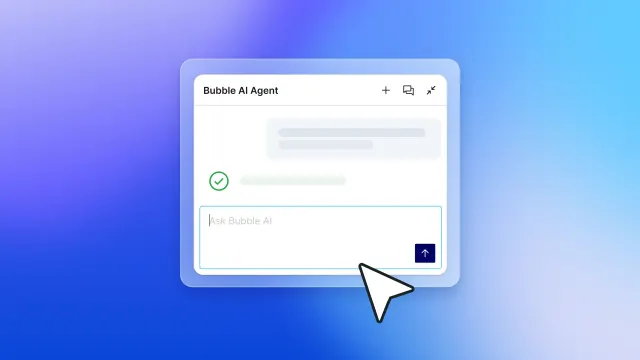
Bubble AI is the AI technology inside Bubble, a fully visual app builder, and you use it by chatting with the Bubble AI Agent. Describe your app in plain language, and the Agent plans it with you, then builds the pages, workflows, database, and privacy rules directly in Bubble’s visual editor. Everything it builds is visual, with no generated code to read or maintain, and you can change any part of it yourself or ask the Agent to.
Generating your app and editing it afterward are one continuous conversation with the Agent. After the first version, you can keep asking the Agent to make changes, and it explains how things work as it goes. Or you can open the visual editor yourself and adjust anything directly, right down to a single field or workflow step.
What does Bubble AI generate?
When you describe your idea to the Agent, it generates a working foundation for your app in four parts: pages and components for web and mobile, visual workflows for your app’s logic, a database with privacy rules, and sample data for testing.
Pages and components for web and mobile
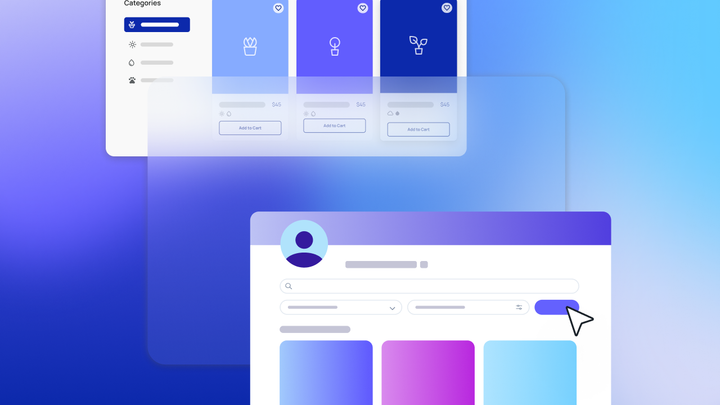
The Agent generates the visual screens of your app, including buttons, forms, navigation, cards, and layouts. These arrive already styled and connected to your data. You can click through everything as soon as generation finishes, and nothing is a mockup you’ll need to rebuild later.
Bubble for native mobile apps lets you build iOS and Android apps in the same editor as your web app, sharing one backend. With native mobile app generation (beta), the Agent can generate native app UI using patterns like bottom sheets, tab bars, and stack navigation. The Agent recently expanded to build and edit every part of your mobile app, including workflows and data, and it can connect your app to third-party services.
Visual workflows and logic you can edit
Workflows are how Bubble handles app logic, meaning the rules for what happens when a user clicks a button, submits a form, or triggers an action. The Agent builds these as visual steps you can read out loud, like “When someone signs up, send a welcome email.”
You can see what each step does and change it without touching code. When the Agent builds or changes a workflow, it works step by step in the editor and explains what changed.
Database structure and privacy rules
The Agent generates your database and its schema, including the data types and fields your app needs to store and retrieve information. For example, it might create a “User” data type with fields for name, email, and profile photo.
Data types work a lot like tables in a spreadsheet. You see the structure visually and adjust it with a few clicks, no SQL required.
The Agent also creates privacy rules automatically for every data type it builds. These rules decide who can see or edit your data. Treat them as a starting point, and review them yourself before you go live to confirm that they match what you need.
Smart sample data for testing
The Agent fills your database with sample records that match your app. For a job board, that might mean example listings and applicant profiles already in place. You can click through the whole app right away and see how it behaves with realistic content instead of testing against an empty database.
How Bubble AI builds an app
Building an app with Bubble AI takes five steps: You shape a plan with the Agent, the Agent generates the app, you test it with sample data, you keep editing with the Agent or in the visual editor, and you deploy when you’re ready.
Step 1: Describe your idea and shape the plan with the Agent
Describe your app in plain language. Something like “a job board where employers can post listings and applicants can apply” is a good starting point.
The Agent then starts a planning session: It asks clarifying questions and drafts a blueprint of the features and user stories your app needs. Confirm what looks right and adjust the rest, or skip planning and generate your app right away.
Step 2: Generate UI, database, and workflows
Once you confirm the blueprint, the Agent builds a working version of your app in one pass. That includes pages, UI components, visual workflows, database structure, sample data, and privacy rules for every data type. It’s all generated together in the same visual editor, and nothing is left for you to wire up separately.
Generating an app doesn’t use AI credits. When it’s done, you’ll have an editable foundation ready to preview and test.
Step 3: Test with sample data
Click through your app’s main flows using the realistic placeholder records the Agent added, with no data to enter by hand. For a job board, sign up as an employer and post a listing, then switch to an applicant and apply. Testing each user role early shows you where the app doesn’t yet work the way you imagined.
Step 4: Edit visually or with the Agent
From here, you can keep building in two ways:
- Chat with the Agent: Describe the change you want, like “Let applicants save listings to a favorites page.” The Agent builds it in the editor and summarizes what changed.
- Edit in the visual editor: Adjust any page, workflow, or data field yourself. This works well for precise changes, like moving a button or tweaking when a step runs, and it doesn’t use AI credits.
Step 5: Deploy when ready
When your web app is ready, you can publish it with one click on a Starter plan or higher. Bubble handles hosting, security, and scaling.
For your iOS and Android apps, Bubble helps you package and submit to the App Store and Google Play Store from the same editor. Some first-time app store steps, like the first Google Play upload, may require manual actions in the developer console.
What the Agent can do after your first version
Most of the work on an app happens after the first version. Once you have one, the Agent can ask clarifying questions, show its plan and summarize its changes, build backend workflows and integrations, debug with your app’s sample data, and work alongside AI tools you already use. You decide what it changes.
Asks before it guesses
When a request could mean more than one thing, the Agent asks clarifying questions before it builds. You can answer with one option, several, or your own words. That keeps small misreads from adding up, and the app keeps working the way you imagined.
Shows its work
The Agent shows what it’s about to do before it starts and summarizes what changed once it finishes. Everything it touches is visible in the editor, so you can check any change yourself. If a change isn’t what you wanted, version control lets you roll back to an earlier version.
Builds backend workflows and integrations
You can ask the Agent to build two kinds of behind-the-scenes functionality:
- Backend workflows: These run without a user clicking anything. Use them for bulk data processing, recurring tasks, and scheduled events, like sending applicants a reminder every Monday.
- Integrations: The Agent can set up API Connector calls to external services, like Stripe, and install plugins from the Bubble Marketplace. Responses from those services come back as data your app can use right away, with no manual mapping.
Debugs with sample data
If you turn it on in your app’s settings, the Agent can use your app’s sample data to spot data problems directly. It can also find buttons that don’t have workflows yet, diagnose why something isn’t working, and explain complex logic in plain language. Those explanations are one of the best ways to learn how your app works as you build it.
Build from Claude or Codex with the Bubble MCP (beta)
If you already use an AI tool like Claude or Codex, the Bubble MCP connects it to your Bubble app. It’s built on Model Context Protocol, an open standard for connecting AI tools to other software. From your own AI tool, you can build and edit UI and features, and everything it builds stays visual and editable in the visual editor.
The Bubble MCP can’t deploy your app yet, so you’ll still publish from Bubble. Work you do through the Bubble MCP doesn’t use AI credits, though you’ll pay for your own AI tool.
How Bubble AI compares to AI coding tools
The main difference between Bubble AI and AI coding tools like Lovable, Bolt, and Replit is how much of the app you can see and change without code. Those tools have helped a lot of people get a first version up fast, and most let you adjust the screens visually, but the logic and backend are still code someone has to read and maintain. On Bubble, the design, database, privacy rules, and logic are all visual and editable in one editor, right from the start.
| Feature Name | Bubble AI | AI coding tools (Lovable, Bolt, Replit) |
|---|---|---|
| Output | Visual, editable apps | Code files, sometimes with a visual UI layer |
| When AI hits its limits | Edit design, data, privacy rules, and logic directly in the visual editor | UI may be visually editable, but deeper logic and backend changes often require prompting, code review, or developer help |
| Security model | Privacy rules created for every data type and editable from the start. Security dashboard included on paid plans. | Some tools offer security scans, but generated code, dependencies, and data-access settings still require careful review |
See why something isn’t working
When an AI coding tool generates code you can’t read and something breaks, you usually have two choices. You can describe the problem in another prompt and check the result, or you can bring in a developer.
Prompting again has limits. A December 2025 study found that AI models’ debugging ability drops 60–80% after just two or three attempts.
On Bubble, you can open the workflow, database field, or design element involved and see what it’s doing. Then fix it yourself in the visual editor or ask the Agent to diagnose it, with no coding knowledge needed.
Edit anything, anytime, visually
On Bubble, you can switch between the Agent and the visual editor at any point in the build, including when you’re changing how the app works. Use AI when you want speed or edit by hand when you want precision, without losing your place or redoing work.
Built-in privacy rules and security scanning
AI coding tools have had serious problems with production data. In July 2025, Fortune reported that an AI agent on Replit deleted a company’s database during a code freeze.
Incidents like this are a good reminder to check your data access, permissions, and security settings yourself before you launch, no matter which AI builder you use.
On Bubble, the Agent creates privacy rules for every data type it builds, and they show up in the privacy editor right away. On paid plans, a security dashboard checks your app for common vulnerabilities, like exposed API keys, before you go live, and Bubble itself is SOC 2 Type II compliant.
What can you build with Bubble AI?
On Bubble’s visual development platform, you can build apps you plan to launch and run as a business. Here are a few types builders commonly create.
- SaaS products and marketplaces: Build a marketplace or subscription product with different types of users, like buyers and sellers. The Agent sets up your database, and you can connect payment services like Stripe for billing right from the visual editor.Ohana, a subletting marketplace built on Bubble, handled 2,700 sublease transactions and $16.2 million in host earnings over 14 months (as of July 2025).
- Internal tools and dashboards: Replace scattered spreadsheets with a custom tool built for your team, like an inventory tracker, CRM, or project dashboard connected directly to your existing data. When the team’s process changes, you can change the tool yourself instead of waiting on engineering.
- Native mobile apps for iOS and Android: Build iOS and Android apps with the Agent, then fine-tune the UI, data, workflows, and backend logic yourself in the visual editor. Your app can use device features like the camera and push notifications while sharing one backend with your web app.SuiteOp, a hospitality operations platform, built its native app on Bubble in two months, compared with an estimated 6–8 months (as of August 2025).
Where Bubble AI has limits
The Agent gives you a strong head start, and you’ll still want to review and refine your app yourself. Here’s where to plan to step in.
- Privacy rules need your review: The Agent creates privacy rules for every data type, but check that they match who should see what before you launch to customers. This matters most anywhere sensitive data, like payment details or health information, is involved.
- Generated mobile apps need thorough testing: Native mobile app generation is still evolving, so click through every screen before you publish, even though a recent update lets the Agent build and edit your whole mobile app. On the Free plan, you can test with the Simulated device option, and paid plans add dev builds for testing on real devices.
- First-time app store setup takes some manual steps: You’ll need developer accounts with Apple and Google, and some steps, like the first Google Play upload, happen in their developer consoles. The native mobile docs walk through what to expect.
- Reading visual logic takes some learning: Bubble’s own terms, like workflows (the steps your app runs when something happens) and data types (where your app keeps track of things like job listings), take time to get used to. The Agent explains what it built in plain language, so you learn how your app works as you build it.
Start building with Bubble AI
Get started for free: Describe your idea to the Agent, shape the plan together, and see every page, workflow, and data type it builds. Generating an app doesn’t use AI credits, and you’ll choose a paid plan when you’re ready to go live. For a closer look at what the Agent can do, explore Bubble AI features.
Frequently asked questions about Bubble AI
How much does Bubble AI cost?
Getting started on Bubble is free: Generating an app with the Bubble AI Agent, including the planning session, doesn’t use AI credits, editing in the visual editor never does, and every plan includes a monthly AI credit allowance for building with the Agent after that. To go live, you’ll need a Starter plan or higher for a web app, or a Mobile or Web & Mobile plan to publish to the App Store or Google Play Store (see the pricing page for current plans).
What happens if I run out of AI credits?
The Bubble AI Agent keeps any work it’s finished and tells you what’s left, and you can keep building in the visual editor or through the Bubble MCP (beta), neither of which uses AI credits. On paid plans, you can buy more AI credits anytime, and nothing is charged automatically.
How do Bubble AI and the Bubble AI Agent work together?
Bubble AI is the technology, and the Bubble AI Agent is how you use it: The Agent starts with a planning session, drafts a blueprint, and generates your app. From there, you keep chatting with the same Agent to add features and change anything you want, or you edit the app yourself in the visual editor.
Can I export the code from an app Bubble AI builds?
No. Apps on Bubble are fully visual, so there’s no generated code to export, and they run on Bubble’s hosting with security and scaling built in. If owning a codebase matters most to you, a code-first tool is the fair choice.
Can I move an app I built with another AI tool to Bubble?
You’ll rebuild it rather than import it: Describe the app to the Bubble AI Agent, including its main users and the actions they take, and the Agent plans and generates a Bubble version you can refine in the visual editor. The rebuild is also a chance to adjust anything in the original that drifted from what you imagined.
Do I need to know how to code to use Bubble AI?
No. Everything the Bubble AI Agent builds is visual, including the logic and data, and the Agent explains what it built in plain language, so you learn how your app works as you go.
Can Bubble AI build native mobile apps?
Yes. With native mobile app generation (beta), the Bubble AI Agent can generate native iOS and Android apps that share one backend with your web app, and you publish to the App Store and Google Play Store from the same editor.
Build for as long as you want on the Free plan. Only upgrade when you're ready to launch.
Join Bubble