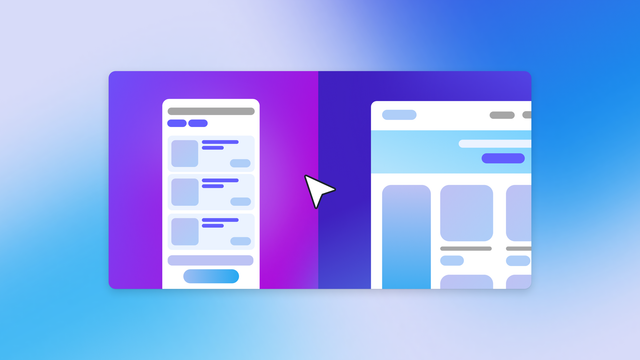
TL;DR: Web apps run in a browser, so anyone can open them instantly and they cost less to build, but they can’t do much with a phone’s hardware. Native mobile apps take more work to build and have to pass app store review, but they run faster and can tap into the camera, GPS, and push notifications.
Most apps you use every day come in two versions: one you open in a browser and one you download to your phone. If you’re building your own, you’ll need to decide up front which to build first, or whether to build both. That choice affects your budget and what your app can do.
This guide covers web vs. mobile development and walks you through the differences, including the technology they use, how you update them, what each can do on a device, and what they cost. You’ll get a framework for choosing web, mobile, or both. And you’ll learn how to use Bubble to build web and native mobile apps (beta) in one editor.
What’s the difference between a web app and a mobile app?
The biggest difference between web and mobile apps is how people get to them. A web app runs in a browser. You open it with a URL, and there’s nothing to install.
A native mobile app is built for a specific mobile operating system, like iOS or Android. People download it from the App Store or Google Play Store, and it can use the phone’s hardware directly, including the camera, GPS, push notifications, and offline storage.
LinkedIn is a good example of both. Open it on your laptop and you’re using its web app. Open it on your phone and you’re using a native app that plugs straight into your phone’s operating system.
Examples of web apps and mobile apps you use daily
The easiest way to see the difference is in apps you already use. You probably switch between both kinds every day without thinking about it.
Web apps
You open these in a browser tab, no download needed.
- Google Docs or Sheets: Open a doc, share the link, and a teammate can be editing alongside you in seconds.
- Trello: Plenty of teams keep a Trello board open in a browser tab all day and drag cards along as work moves.
- Facebook (on your computer): Log in on your laptop and you can post and message friends without installing a thing.
Mobile apps
These live on your phone. You download them once from the App Store or Google Play Store, and after that they’re a tap away.
- Instagram: You can post photos and Reels from the web now, but Stories, camera effects, and the best creation tools are still only in the app.
- Google Maps: Download a map in the app before a trip and it can still guide you when you lose signal. The web version can’t do that.
- Uber or Lyft: Request a ride and the app uses your phone’s GPS to find a nearby driver and track your trip in real time.
Key differences between web and mobile app development
Web and mobile development share a lot of the same basics. The big differences are in how the finished app reaches people and how they use it, and those drive most of the decisions you’ll make. Here’s how the two compare side by side.
| Web apps | Native mobile apps | |
|---|---|---|
| How users access it | Open a URL in any browser, with nothing to install | Download from the App Store or Google Play Store |
| Technology | HTML, CSS, and JavaScript | Swift (iOS), Kotlin or Java (Android), or a cross-platform framework like React Native |
| Updates | Go live for everyone instantly | Go through app store review, and some users stay on older versions |
| Device access | Location, camera, microphone, and push notifications with permission, but less hardware access overall | Camera, location, push notifications, gestures, and local storage |
| Offline use | Can work offline if built as a progressive web app (PWA), but most web apps rely on a connection | Can store data on the device and work offline |
| Performance | Depends on the browser and connection | Built for the operating system, so faster and more responsive |
| Cost | One codebase for every device | Separate iOS and Android builds, plus developer account fees |
| Discovery | Search engines and links | App store search and a home screen icon |
Underlying technologies
Web apps use HTML, CSS, and JavaScript, while native mobile apps use a separate language for each platform: Swift for iOS and Kotlin for Android. That’s why companies have traditionally needed separate teams for web, iOS, and Android. No-code tools and AI app builders let you build without knowing how to write code in any of those languages.
Distribution and deployment
Getting an app to users and keeping it updated works very differently on each platform.
Web apps: You host the app on a server, and people reach it through a URL. When you push an update, everyone gets the new version the next time they load the page.
Native mobile apps: Every release goes through review by Apple or Google before it reaches users. Once it’s approved, people update on their own schedule (some have automatic updates on, some don’t), so part of your user base can stay on older versions for a while.
UX/UI best practices
You use a phone with your hand and a laptop with a mouse, so each one needs a different design.
Native mobile apps are all about touch: swiping, long-pressing, pulling down to refresh. Navigation bars sit within easy reach of your thumb, and gestures feel natural because they mimic how you’d move real objects.
Web apps are built around a mouse and keyboard. Hover effects, right-clicks, and layered menus work well on a desktop, but they need responsive design to hold up in a mobile browser.
Access to device features
A phone is packed with hardware your app might want to use, and how much it can reach depends on how the app is built.
Native mobile apps can reach deeper into the phone. A banking app can scan a check with your camera, and a delivery app can buzz you the moment your food arrives.
Web apps get less access, but progressive web apps (PWAs) have closed some of the gap. You can add one to your home screen like a regular app, and it can use your location, camera, microphone, and push notifications. It still won’t feel quite as smooth as a native app, though.
How much does it cost to build a web app vs. a mobile app?
For a lot of teams, cost settles the question. Native mobile apps usually take a bigger budget because you’re building for iOS and Android separately and waiting on app store reviews. There are also developer account fees: $99 a year for Apple and a one-time $25 for Google Play.
Web apps tend to cost less to build and maintain since one codebase runs in every browser. Bubble cuts the cost of building both, because web and mobile share one backend and you only build your database and workflows once.
Web app vs. mobile app: pros and cons
Each approach has clear strengths and a few trade-offs.
Web apps
| Web apps pros | Web apps cons |
|---|---|
| ✅ Anyone with a browser can open them instantly | ❌ Can't reach much of the phone's hardware |
| ✅ Updates reach everyone at once | ❌ Usually need a connection unless built to work offline |
| ✅ One codebase covers every device | ❌ Can feel slower than a native app |
| ✅ Cheaper to build up front |
Native mobile apps
| Native mobile apps pros | Native mobile apps cons |
|---|---|
| ✅ Faster and smoother to use | ❌ Cost more to build for both iOS and Android |
| ✅ Can tap into the phone's hardware | ❌ Every release needs app store approval |
| ✅ Can work offline | ❌ People have to download them before using them |
| ✅ Push notifications bring people back |
When to choose web vs. mobile vs. both
There’s no single right answer, but your budget and how people will use your app narrow it down fast.
Choose a web app if:
- You want to reach as many people as possible, fast. Share a link and anyone with a browser is in, which is why quick-use tools like calculators and booking forms usually live on the web.
- You’re working with a tight budget. One web app costs far less than separate iOS and Android builds, and there’s only one codebase to keep up.
- You’ll be shipping changes often. Fix a bug in the morning and every user has the fix by lunch, with no app store review in between.
Choose a mobile app if:
- Your app runs on the phone’s hardware. If people will scan receipts with the camera or track a run with GPS, go native.
- Speed and polish matter most. Native apps are built for the phone’s operating system, so scrolling and tapping feel instant.
- You want your app to become a daily habit. A home screen icon and a well-timed push notification keep people coming back.
- People will use it without a signal. Native apps can store data on the phone, so a field tech or a traveler can keep working offline.
Build both if:
- You want each platform to feel its best. A web app catches everyone who finds you through search, and a mobile app gives your regulars something faster in their pocket.
- You’re not sure where your users will land. Some will find you on a laptop and others on a phone, and building both means you don’t have to guess.
- Your users expect it. People want to check their bank balance or project board from whichever device is closest, laptop or phone.
Building both web and mobile apps together
Traditionally, a web app and a mobile app are separate builds, so every new feature gets built once per platform and then kept in sync. Cross-platform frameworks like React Native cut that down by sharing code between iOS and Android, and PWAs bring some app-like features to the browser. Both help, but you’re usually trading cost against how native the app feels.
On Bubble, your web and native mobile apps live in one project. Build your database and workflows once, and both apps use them.
Native mobile vs. web app development on Bubble
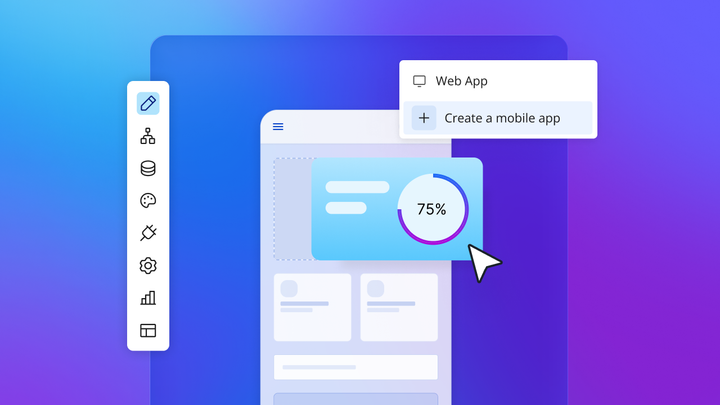
On Bubble, your web and mobile apps share the same backend, so your data and workflows carry straight over when you add mobile. The screens are where the two part ways. A phone needs navigation built for a thumb and elements sized for tapping, so Bubble’s native mobile editor gives you its own set of components to design with.
“To me, the biggest highlight of building native mobile apps within Bubble is doing everything within the same ecosystem. So far, Bubble’s mobile builder has been so much easier to use than trying to wrap a web app with plugins. They just never quite feel native. As far as similarities, everything you know about logic, workflows, and elements still applies when transitioning from web to mobile.” — Justin Kyser, director of innovation at LRS Healthcare
You can generate a mobile app from scratch with Bubble AI or add one to a web project you’ve already built. Before launch, you can send iOS builds to TestFlight to get feedback from beta testers. After launch, over-the-air (OTA) updates let you push changes to text, UI, and workflows without going back through app store review.
Interaction patterns: clicks vs. touch
A web app mostly has to handle clicks. A mobile app has to handle every way a thumb moves: taps, swipes, long presses, pans, and pinches. Bubble’s native mobile editor supports all of them, so you can let people swipe a row to archive it or tap to choose from a selectable list.
Displaying data: repeating groups vs. native lists
On the web, Bubble shows lists of data in repeating groups. On mobile, you’ll use vertical lists and section lists, which are built for scrolling with a thumb. Section lists group items under headers, like the contacts on your phone sorted by letter.
Navigation: pages vs. tabs, stacks, and modals
On the web, people move between pages, usually through a header menu or sidebar, and every page has its own URL. Mobile apps use views instead, and Bubble gives you three ways to move between them.
Tabs sit along the bottom of the screen for your app’s main sections, like home and settings.
Stacks let people tap deeper into your app and get back out with a built-in “back” button.
Modals open on top of the current view for quick tasks like editing a profile or submitting a form.
For extra options or details, you can use a bottom sheet that swipes up from the bottom of the screen instead of a traditional popup.
Embedded content: web views vs. native components
Embedded content means showing a page inside your app instead of building that screen from scratch. If you already have a web app, you can save some time by using the web view element in Bubble’s native mobile editor. It can display pages from your own Bubble web app inside a mobile view.
For most screens, though, rebuilding with native components gives you a faster, more touch-friendly app. The web view element can’t load outside websites or let people click through to other pages, and native features like the camera won’t work inside it. The Bubble AI Agent (beta) can help you decide which route fits.
Plugins and frameworks
Plugins add features you’d otherwise build yourself, like payments or maps. On the web, most of them run on JavaScript.
Bubble’s native mobile apps run on React Native (the same framework Meta, Microsoft, Amazon, and Shopify use), so they need plugins built for mobile. Developers can now build them with the new mobile plugin editor (beta) using third-party npm libraries, but not every plugin supports mobile yet, so check before you build around one. The Agent can install free or already-purchased plugins for you, flag conflicts, and guide you through uninstalling them.
What to know before launching your app
Building your app is only part of the job. Getting it into the app stores takes some prep, and these tips from experienced builders can help.
Familiarize yourself with mobile design
Mobile design has its own rules. Buttons need to be big enough to tap, and key actions should sit where a thumb can reach them on a much smaller screen. Before you start building, look at how popular apps in your category handle the same screens you’re planning.
Here are a few places to get design inspiration:
- Page Flows: Watch recordings of full user flows from popular apps, like signing up, booking, or checking out.
- Mobbin: Browse a large library of iOS, Android, and web screens from top apps, categorized by screen type, pattern, or flow.
Understand app store guidelines
Before your app goes live, Apple and Google both have to approve it. Knowing what they look for ahead of time can save you a round of rejections.
Here are a few key guidelines to keep in mind:
- Apple App Store: Apple’s review is known for being strict about polish and functionality. Your app has to be a finished version with no placeholder content (Guideline 2.1), and it needs a privacy policy and a clear explanation for every permission it asks for (Guideline 5.1.1).
- Google Play Store: Google asks you to fill out details about your app, including its target audience and how it handles user data, and to follow its policies on content, privacy, and security.
“Everything went through smoothly, and the app was approved and published much faster than we anticipated — even on the same day of submission. It was an exciting and unexpected milestone for us! For first-time developers, though, it’s helpful to understand the requirements for creating developer accounts, preparing app assets, and ensuring compliance with platform guidelines to avoid delays.” — Rokas Jurkėnas, founder and CEO of Idea Link
Start building for web and mobile today
If most people will find you through search or only stop by now and then, a web app is quicker and cheaper. If your app needs to use the phone’s hardware or you want it to become a daily habit, native mobile is worth the extra work. And plenty of products end up needing both.
Bubble lets you vibe code without the code: Describe your idea, and Bubble AI generates a working first version in minutes. Keep building with the AI Agent, or fine-tune every detail in the visual editor before you launch. Web and mobile use the same backend, so you can start with one and add the other later.
Join nearly 6 million builders and start building for free today.
Frequently asked questions about web apps vs. mobile apps
Does Bubble use React Native, or is it a web view wrapped as an app?
Bubble is built on React Native and generates true native iOS and Android apps rather than web views wrapped as apps. Your app gets native performance and access to device capabilities like the camera, location services, and push notifications.
Can I build one app that works on both web and mobile on Bubble?
Yes, Bubble lets you build responsive web apps and native iOS and Android apps from a single visual editor. All three share the same database, workflows, and backend logic, so you maintain one project instead of separate apps for each platform.
Can a web app become a mobile app?
Yes, you can wrap a web app in a native container and publish it to the app stores, but the result usually doesn’t feel like a native app. On Bubble, you can build a native mobile interface on top of your existing web app instead, keeping your workflows and database while giving users the performance and design they expect on a phone.
Which is easier to build: web apps or mobile apps?
Traditionally, web apps are faster to build because they need only one codebase across all browsers, while native mobile apps need separate builds for iOS and Android. Bubble speeds up both by combining AI generation with a shared backend in one editor, though a native mobile launch still takes mobile UI work, testing, and app store review.
Is AI changing which type of app you should build?
Not really. The differences in device access, performance, and how people use web and mobile apps stay the same no matter how you build. AI mostly changes the speed, and on Bubble, AI generates a first version of your app while the visual editor lets you refine and launch it on web and native mobile from one shared backend.
Build for as long as you want on the Free plan. Only upgrade when you're ready to launch.
Join Bubble