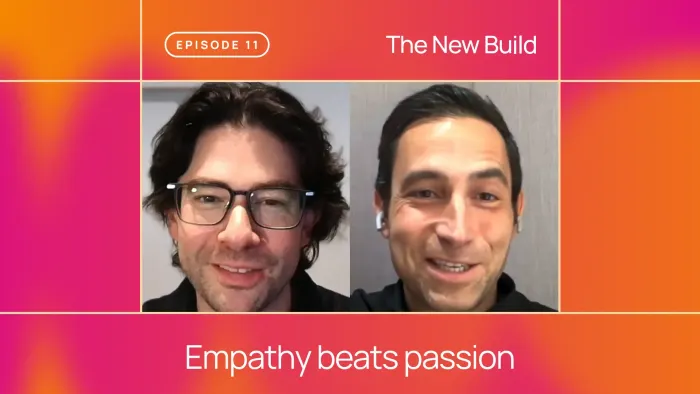
Scott Belsky has spent his career on both sides of the product equation. As founder of Behance and Adobe’s Chief Product officer, he was helping build products used by millions. As an angel investor, he saw how products succeed or fail.
In this episode of The New Build, Scott talks through what building Behance, backing numerous founders, and watching products succeed and fail has taught him about why passion alone is a poor guide for what to build.
About Scott Belsky
Scott Belsky spent the early part of his career watching creative professionals struggle to be found — talented people whose work sat in outdated portfolios and personal websites nobody visited.
That observation became Behance, which he founded in 2006 and built into the leading platform for creative professionals before Adobe acquired it in 2012.
At Adobe, Scott served as Chief Product Officer and Chief Strategy Officer across a period that saw the company move its products to mobile and the cloud and launch Adobe Firefly. Away from his operating roles, he has backed over a hundred companies as an angel investor, including Ramp, Pinterest, Uber, and Bubble. He is also a Partner at A24 and the founder of A24 Labs, the studio's internal technology division focused on building tools for creative workflows, and the author of The Messy Middle and Making Ideas Happen.
About The Messy Middle
The “messy middle” is the term Scott uses in this episode to describe the volatile stretch between starting something and knowing it's going to work. His book of the same name distills over five years of interviews with founders, artists, and executives about how to get through it. It covers how to endure the lows, optimize the highs, and build the kind of team and product that makes it to the other side.
What you'll learn in this episode
Scott has thought hard about why so many products miss because passion alone is a poor guide for what to build. This conversation covers his framework for using empathy to find the real problem your users have, why the optimism that helps founders get started can become a liability in the long run, and what it looks like when a team is building a product but not a culture. Scott also gets into what he looks for when backing founders, and what drew him from the product world to film.
Whether you're defining your first product or trying to figure out why traction isn't coming, this episode offers a grounded look at how the most experienced builders think about the gap between what users say they want and what they actually need.
Episode timestamps
[00:00:33] Abhinav introduces Scott Belsky — founder of Behance, former Adobe CPO, now partner at A24
[00:02:13] Scott's unlikely path from Goldman Sachs to entrepreneurship, and what drew him to design along the way
[00:05:45] What Behance's first (and only) focus group revealed: creatives didn't think they needed another network — and why they were wrong
[00:09:43] Common founder mistakes: ignoring human psychology, and why building culture matters as much as building a product
[00:12:44] Defining the messy middle: the leader's job is to narrate progress and help teams endure volatility between launch and success
[00:18:11] What it felt like to lead product inside Adobe after the Behance acquisition — and the opportunity to help refound its cloud strategy
[00:21:06] How builders should think about AI models: why staying model-agnostic matters, and the difference between content creators and artists
[00:24:28] Why Scott joined A24 and what excites him about new IP and risk-taking storytelling in an era of sequels
[00:31:45] What Scott looks for when investing in founders: curiosity, product sensibility, and asking "would I work for this person?"
[00:37:30] The one lesson Scott wishes he'd had at Behance: knowing when not to be a contrarian
Key insights from this episode
Empathy is a more reliable compass than passion
Passion gets you building, but without understanding what users actually struggle with, you can spend years solving the wrong problem. When founders build from passion alone, Scott says, they spend their energy on a vision of the solution rather than a clear picture of what users are actually struggling with.
Instead, he recommends asking users whether they want what you're building, ask what they're suffering from. The answers are often more useful and more humbling than any validation you'd get by just pitching your idea.
The question you ask determines the answer you get
Behance's first and only focus group was pretty unambiguous. Creatives didn't need another place to put their work because they already had personal websites, DeviantArt, MySpace. Scott's team could have pushed forward on conviction, but instead they asked what people were finding hard.
The feedback group brought up getting credit for their work, being discovered by people who didn't already know them, and organizing a portfolio that was always out of date. The list mapped almost exactly to what they'd been planning to build. Asking what people struggle with will get you further than asking whether they want what you're building.
Building a product without building a culture is a common and costly mistake
Scott's view is that competitive startups tend to succeed because they stick together long enough to figure it out. Lessons and culture compound on themselves, and teams that stay together build on each prior version of the company rather than starting over. What pulls teams apart is rarely one big moment, but rather the slow drift that comes when people don't feel like they're part of something worth staying for.
His advice is to treat the narrative you tell your team with the same care you give the product. Founders who keep people informed of the progress being made, even in hard stretches, give teams a reason to stay heads down when the outside world looks more appealing.
Optimism is a founder's greatest asset and a genuine blind spot
The optimism that makes founders good at starting things, at hiring, at inspiring a team, at pushing through, is the same trait that makes it hard to think clearly about what might go wrong. Scott sees this pattern across the founders he's backed and in Silicon Valley.
The tendency, he argues, is to be far more creative about what can go right than what can go wrong. He points to social media and algorithms as a clear example of what happens when that blind spot goes unexamined. His view is that founders need to bring the same imaginative energy to what could fail as they bring to what could work.
Resources
- Behance — Scott's portfolio platform for creative professionals, now part of Adobe
- The Messy Middle by Scott Belsky — His book on navigating the volatile stretch between starting a company and knowing it's going to work
- Adobe Firefly — Adobe's generative AI product, launched during Scott's tenure as Chief Product Officer
- A24 — Independent film and entertainment studio where Scott is now a Partner
- Adobe 99U Conference — Annual conference Behance ran to bring the creative community together
- Isaac Mizrahi — Designer quoted in the episode: "Creativity is a mistake of the eye"
Listen and subscribe
The New Build is a bi-weekly podcast exploring how solo founders and small teams are building products that reach millions of users. New episodes drop every other week.
Subscribe: YouTube · Spotify · Apple Podcasts
Build for as long as you want on the Free plan. Only upgrade when you're ready to launch.
Join Bubble