TL;DR: Employee onboarding is a 90-day to 1-year process that helps new hires succeed through preboarding, orientation, training, and ongoing support. Good onboarding improves retention, productivity, and engagement. It needs clear phases, defined roles for HR and managers, regular check-ins, and metrics to track progress.
Your first impression as an employer happens during onboarding. Get it right, and new hires become productive team members who stick around. Get it wrong, and you're back to recruiting within months.
This guide walks through everything you need to build onboarding that works: what it actually means, why it matters for your bottom line, and how to create processes that scale from your first hire to your hundredth.
What is employee onboarding?
Employee onboarding is the process of integrating new hires into your organization. This means helping them understand your culture, learn their role, and become productive members of your team.
Think of it like moving into a new neighborhood. When neighbors welcome you, show you around, and help you figure out where everything is, you settle in faster and feel like you belong. But when you’re dropped off with no guidance, you spend weeks feeling lost. That’s the difference between good onboarding and just handing someone an employee handbook on day one. According to Gallup, only 12% of employees strongly agree their organization does a great job of onboarding.
Onboarding isn’t the same as orientation, though people often confuse the two. Orientation is typically a one-day or one-week introduction covering basics like paperwork, policies, and where the bathrooms are. Onboarding is much bigger. It’s a months-long process that includes cultural integration, skill development, and ongoing support.
| ⭐ Orientation | ✨ Onboarding | |
|---|---|---|
| Duration | 1 day to 1 week | 90 days to 12 months |
| Focus | 📋 Paperwork and policies | 🎯 Culture, skills, and performance |
| Who leads | 👔 HR department | 🤝 HR, managers, and teams |
| Goal | ✅ Complete requirements | 🚀 Build engagement and productivity |
| Activities | Forms, tours, policy review | Training, mentoring, goal-setting |
The scope matters because onboarding sets the foundation for everything that follows. It starts before the first day and continues for months, with clear phases and checkpoints along the way.
Why does employee onboarding matter?
Good onboarding directly affects whether people stay, how fast they become productive, and how engaged they feel. When you get it right, new hires reach full productivity faster and stick around longer. When you skip it or rush through it, you end up replacing people within months.
The cost of getting this wrong shows up in multiple ways, with turnover averaging 33% of an employee’s base pay. You lose the time you invested in recruiting and interviewing. You start the hiring cycle over. Your team loses momentum while covering for the empty role. And the person who left might share their negative experience with others in your industry.
But the benefits of doing it well go beyond avoiding those costs:
- Faster productivity: People who understand their role and have proper training contribute meaningful work within weeks instead of months.
- Better retention: Positive first impressions make people feel valued and supported, which reduces early turnover.
- Stronger culture fit: Consistent messaging about your values helps new hires understand what makes your organization unique.
- Clearer expectations: When managers and new hires align on goals early, you prevent misunderstandings and build trust.
- Higher confidence: People who receive proper support feel more capable and engaged in their work.
The first few months shape how someone views your organization for years. Enboarder’s research found 86% of new hires decide their tenure within the first six months. That initial experience sets their expectations for communication, support, and growth opportunities. You’re building a relationship that affects your entire team’s success.
The key phases of employee onboarding
Effective onboarding follows a clear progression from preboarding through the first year. Each phase builds on the previous one, moving new hires from “excited but nervous” to “confident and productive.”
Understanding these phases helps you design experiences that meet people where they are. You can’t cover everything on day one, and you shouldn’t try. Instead, you introduce information and support at the right time for each person to absorb it.
Preboarding
Preboarding happens between offer acceptance and the first day. This phase handles administrative tasks so day one can focus on welcome and connection instead of paperwork.
A welcome email should cover first-day logistics, parking information, and what to expect. You can introduce team members through short bios or a welcome video, and share reading materials that provide context about your organization’s mission or recent projects. IT equipment, accounts, and workspace setup all happen before the person arrives, so they can focus on connecting with their team instead of troubleshooting technical issues.
This phase is also when you’ll collect required documentation like tax forms, direct deposit information, and emergency contacts. Handling these administrative items ahead of time shows respect for the new hire’s time and demonstrates that your organization is prepared and organized.
First day orientation
The first day centers on creating a welcoming environment where new hires feel ready to begin. Share your company’s mission, values, and culture through conversations rather than long presentations. Introduce team members and key people they’ll work with regularly. Walk through the workspace or provide a virtual tour for remote employees.
Basic setup activities like computer login and email access should happen smoothly because you prepared during preboarding. If technical issues come up, having IT support readily available shows new hires they’ll get help when problems occur.
The goal isn’t cramming in every detail about your organization. Your focus should be on creating a positive emotional experience. People remember how you made them feel more than the specifics you told them.
First week integration
Week one transitions from orientation to actual work. Role-specific training begins, often starting with shadowing experienced team members or completing structured learning modules. Assign an onboarding buddy: someone who can answer everyday questions and help the new hire navigate informal cultural norms.
Schedule initial meetings with key people they’ll collaborate with. These conversations help new hires understand how their role connects to broader organizational goals. Give them early tasks that are meaningful but achievable, building confidence through small wins.
Check in daily or every other day during week one. This is how you catch confusion early and show that you care about your employees’ success.
30-60-90 day development
The first three months establish progressive goals and skill-building milestones. At 30 days, new hires should understand basic job responsibilities and how your organization works. At 60 days, they should contribute independently on core tasks. By 90 days, they should be fully productive and starting to identify opportunities for improvement.
Structure this phase with regular feedback sessions and clear performance expectations. Many organizations write goals for each 30-day period, reviewing progress together and adjusting as needed. This prevents people from drifting without clear direction.
Check-ins shift from daily to weekly, then to every other week as confidence grows. Use these meetings to address challenges, celebrate progress, and reinforce connection to team goals.
Long-term integration (6–12 months)
Between months six and 12, onboarding transitions to regular performance management. New hires should be fully integrated into team culture, contributing at expected levels, and beginning to develop specialized expertise or take on new challenges.
Career development conversations become more important during this phase. Discuss growth opportunities, skill development interests, and potential paths forward. This shows you’re invested in your employee’s future, not just their current role.
By month 12, what was once onboarding becomes standard team membership. The structured support fades, but the relationships and cultural foundation remain.
How to build an effective onboarding process
Building onboarding that works requires structure, consistency, and clear ownership. The most effective processes combine timelines with flexibility for individual needs.
Start by mapping activities to specific timeframes. What must happen before day one? During week one? By day 30, 60, and 90? Creating this timeline prevents important steps from getting missed and ensures consistency across all new hires.
Your timeline should separate required activities from recommended ones. Required items might include compliance training, system access setup, and initial performance goals. Recommended activities could be optional learning resources or networking opportunities.
Build in buffer time for unexpected delays. If you plan for IT setup to take two days instead of one, you won’t panic when reality doesn’t match the ideal scenario.
Create comprehensive checklists
Checklists ensure nothing falls through the cracks while distributing work across multiple people. Develop both master checklists and role-specific variations.
The master checklist covers universal requirements:
- Benefits enrollment and payroll setup
- Workplace safety training
- System access and equipment provisioning
- Company policy review
- Initial manager meetings
Role-specific checklists address specialized needs:
- Technical tool training for engineers
- Sales methodology for account executives
- Customer service platform access for support roles
- Industry-specific compliance for regulated positions
Each checklist item should include who’s responsible, when it should be completed, and any dependencies. For example, “Manager schedules 30-day goal-setting meeting” depends on “HR sends onboarding timeline to manager.” Making these connections visible prevents bottlenecks.
Establish clear roles and responsibilities
Onboarding involves multiple people, like HR, IT, the direct manager, team members, and the new hire. Confusion about who does what leads to duplicated effort or dropped tasks.
Define ownership clearly for each activity. Create handoff procedures between departments. When does HR’s responsibility end and the manager’s begin? What happens if IT setup isn’t complete when the manager is ready to start role training?
Consider who needs to be involved at each stage:
- HR handles preboarding logistics, benefits enrollment, and policy orientation
- IT manages equipment setup, account creation, and technical access
- Managers lead role-specific training, goal-setting, and performance feedback
- Team members provide peer support, answer questions, and model culture
- Buddies offer informal guidance and help with day-to-day navigation
Clear protocols prevent finger-pointing and ensure smooth transitions between phases.
Build feedback and improvement loops
The best onboarding processes evolve based on input from new hires and managers. Schedule surveys at key milestones; for instance, after week one, month one, and month three. Ask specific questions about what helped most, what was confusing, and what was missing.
Manager feedback is equally valuable. They see how well onboarding prepared people for actual work. When multiple new hires struggle with the same skill or knowledge gap, that signals a process improvement opportunity.
Review feedback quarterly and make incremental improvements. You don’t need to overhaul everything at once. Small, consistent adjustments based on real input create compound improvements over time.
Measuring onboarding success
What gets measured gets improved. Without clear metrics, you’re guessing whether onboarding works. Building your onboarding platform in Bubble means you can track all these metrics in one place. Use Bubble AI to generate tracking dashboards in minutes, then you can easily customize how your data is displayed using Bubble’s visual editor.
Some key indicators to track:
- Time to productivity: How quickly new hires reach expected performance levels, measured through manager assessments or objective output metrics
- Retention rates: Percentage of new hires who remain after 90 days, six months, and one year
- Satisfaction scores: New hire ratings of their onboarding experience using consistent questions across all hires
- Manager confidence: Manager ratings of new hire readiness at 30, 60, and 90 days
- Process completion: Whether onboarding activities get completed on time
The timing of your measurements matters as much as what you measure. Week-one surveys capture first impressions and orientation effectiveness. Month-one surveys assess initial training quality. Three-month surveys evaluate overall integration and readiness.
Compare your metrics across departments, roles, or hiring managers. Patterns in the data often reveal opportunities for targeted improvements. If engineering hires consistently report confusion about cross-functional processes, that’s a specific problem you can address.
Scaling onboarding with technology
As organizations grow, manual onboarding processes break down. What works for five new hires per year becomes impossible with 50.
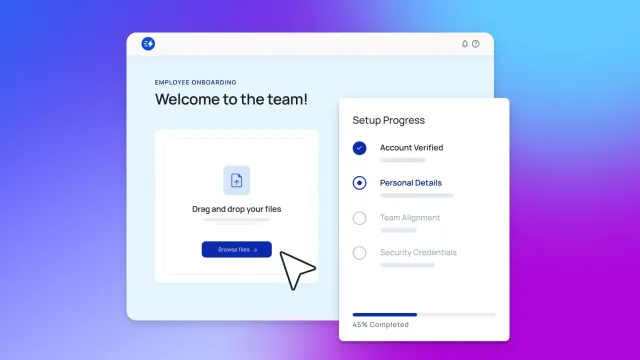
Digital employee onboarding platforms centralize all activities, documents, and communications in one place. New hires can access everything they need without hunting through emails or asking multiple people where to find information.
Workflow automation handles repetitive tasks like sending welcome emails, creating accounts, or scheduling check-in meetings. When someone accepts an offer in your hiring system, automation can trigger the entire preboarding workflow without manual intervention.
Mobile access matters for roles where new hires might not have immediate computer access. With Bubble, you can build native iOS and Android onboarding apps from the same visual editor, so employees can complete training through a native mobile app that feels professional.
Standard onboarding platforms work well for generic workflows, but they fall short when your team has unique processes, specific compliance needs, or integration requirements that off-the-shelf tools can’t handle. Building custom onboarding technology solves this, but traditional development takes months; meanwhile, AI coding tools can help you build something fast, but generate code you can’t maintain yourself.
Bubble gives you a third option: Generate working portals in minutes with AI, then edit and update every detail of your onboarding process through visual workflows, with no code required. This includes:
- Visual workflow automation that you can see and edit directly. Chat with AI to generate automated task triggers, then refine the logic through flowcharts instead of code.
- Document management built on Bubble’s visual database. Let AI generate data structures for employee files, with privacy rules automatically created to secure sensitive information.
- Progress tracking dashboards that are responsive by default for any device. Generate your dashboards with AI in minutes, then customize visually to match your exact needs.
- API integration with your existing HR and IT systems through Bubble’s point-and-click API Connector. The AI Agent provides step-by-step guidance for complex integrations.
- Role-based customization through visual conditional logic. Ask the Agent to set up different flows for each department, then refine the conditions yourself without touching code.
Get started with better onboarding
Employee onboarding is your first opportunity to deliver on the promises you made during recruiting. The investment you make in structured, supportive onboarding pays back through higher retention, faster productivity, and stronger team culture.
Start by assessing your current state. What do you already do well? Where do new hires consistently struggle or express confusion? Use that insight to prioritize improvements.
Take these immediate next steps:
- Map out your ideal onboarding timeline from offer acceptance through 90 days
- Create a simple checklist for your next new hire and track what works versus what gets missed
- Schedule a feedback conversation with your most recent hire to learn what could be better
- Identify one repetitive onboarding task that could be automated
As you build more structured processes, Bubble’s AI + visual approach helps you scale without sacrificing quality.
Ready to build onboarding workflows that grow with your team? Start building with Bubble’s Free plan to vibe code without the code and launch your custom onboarding portals.
Frequently asked questions
What’s the difference between employee onboarding and orientation?
Orientation is a short-term introduction covering basics like policies and paperwork, while onboarding is a comprehensive months-long process that includes cultural integration, skill development, and performance support.
How long should the employee onboarding process last?
Most effective onboarding programs extend 90 days to six months. Simple roles may require shorter timelines, while complex positions benefit from longer structured support and development.
What are the main phases of employee onboarding?
The main phases include preboarding (offer acceptance to first day), orientation (first day welcome), integration (first week of role training), 30-60-90 day development (progressive skill building), and long-term integration (six to twelve months of ongoing support).
How do you onboard remote employees effectively?
Remote onboarding requires digital collaboration tools, structured virtual meetings, and clear communication protocols. Focus on creating connections through video calls, digital buddy systems, and accessible online resources.
What should be included in an employee onboarding checklist?
Include IT setup, access provisioning, compliance training, role-specific resources, buddy assignment, manager meetings, and feedback collection. Customize based on your organization’s specific requirements and culture.
Build for as long as you want on the Free plan. Only upgrade when you're ready to launch.
Join Bubble