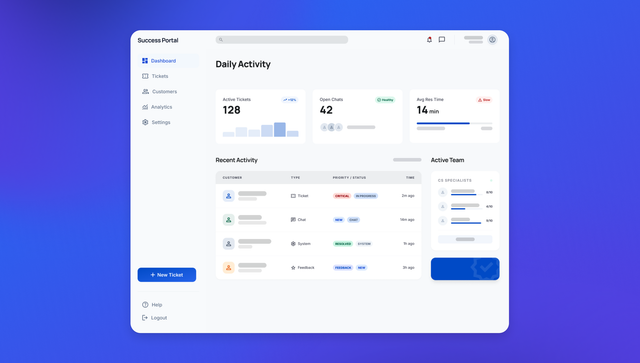
TL;DR: Build a complete AI ticketing system with Bubble’s visual platform. Connect AI services to automatically analyze, categorize, route, and respond to support requests. Create your database, configure AI connections, build workflows, and deploy to production with one click, all without writing code.
Think about the last time you submitted a support request. You filled out a form, hit send, and waited. Behind the scenes, someone had to manually read, categorize, and route your message. What if you could build a system that automates all of that, and have it running in production within hours? With Bubble’s AI app builder, you can.
Support teams are drowning in tickets. Industry data shows support ticket volumes increased 25% year-over-year in 2025, with no signs of slowing. Meanwhile, off-the-shelf solutions often don’t fit your exact workflow.
In this guide, you’ll learn how to build a complete AI ticketing system with Bubble, from generating your initial app with AI to customizing workflows, managing data, and deploying to production. You’ll see how Bubble’s “vibe code without the code” approach lets you build faster than traditional development while maintaining full control over every detail.
What is AI in ticketing?
AI ticketing uses natural language processing and machine learning to automate how support requests are processed, from the moment a customer submits a question to final resolution. Instead of manual triage and routing, AI analyzes message content, identifies customer intent, determines urgency, and triggers appropriate actions automatically.
When you build an AI ticketing system with Bubble, you’re creating workflows that handle what support teams traditionally do manually: reading tickets, categorizing issues, routing to the right team, and responding with solutions. The difference is speed and scale. AI processes hundreds of tickets in seconds with consistent accuracy.
Here’s how it works: When a customer submits a ticket, your Bubble app sends the message to an AI service (like OpenAI or Claude) through the API Connector. The AI analyzes the text and returns structured data: what the customer needs, how urgent it is, and which category it belongs to. Your Bubble database stores this information along with the original message.
Then, workflows you build in Bubble use that AI analysis to make routing decisions. If it’s a billing question, route to finance. If it’s urgent, escalate immediately. If it’s a common issue, trigger an automated response. You define these rules visually, with no code required. Over time, your database accumulates ticket history that helps you refine your workflows and improve accuracy.
This approach lets you automate repetitive support work while routing complex cases to human agents, giving you a custom support platform that would have required a traditional development team before AI and no-code.
Why build your own AI ticketing system
Building your own AI ticketing system addresses common challenges teams encounter with support workflows. Traditional development typically requires months of work and significant developer resources. Off-the-shelf platforms often require adapting your processes to fit their predetermined workflows. Bubble’s approach lets you generate a working app foundation using AI, then customize the details to align with your team’s specific needs.
This approach provides flexibility over your system’s architecture. When you build with Bubble, you control the logic, data structure, and workflows. Custom fields can be added through the visual editor. Routing rules can be adjusted to reflect your team’s specialties without writing code. Existing systems like CRMs or billing platforms can be connected through Bubble’s API Connector, allowing you to build what your workflow requires without depending on vendor development timelines.
Key considerations include:
- Development timeline. Moving from concept to production typically happens in days rather than months, up to 90% faster than traditional development
- Resource allocation. Building with Bubble requires a subscription rather than developer salaries or agency contracts
- Workflow alignment. Create processes that match your team’s needs rather than adapting to generic solutions
- Data management. Your customer support data resides in your Bubble database
How to build an AI ticketing system with Bubble
An AI ticketing system handles four distinct stages through automated workflows.
Intelligent intake and analysis
When a customer submits a form or sends a message, a workflow triggers immediately. Using an API Connector, the message gets sent to an NLP service (like OpenAI or Claude) which analyzes the content and returns structured data.
The workflow receives the AI response and stores key details in your database — things like intent, mentioned entities, sentiment, and urgency. These fields in your database trigger routing logic based on the parsed data.
Automatic classification and routing
Once AI analyzes a ticket, workflows use that categorization to route it to the right team. You’ll create an option set for categories (billing, technical, feature request) and build conditional logic that assigns tickets based on those categories.
Your routing can be as sophisticated as you need. Store agent data in your Bubble database with fields for skills, current workload, and past performance. Then build workflows that query this data and make intelligent assignment decisions based on multiple criteria. You can also define SLA rules—like “respond within 2 hours” or “resolve within 24 hours” using database fields and workflow conditions, all through Bubble’s visual editor.
Response generation and self-service
Build workflows that trigger automated responses for common issues. For example, when a ticket is categorized as “order status,” your workflow queries the database for the order, retrieves tracking information, and sends an email, all automatically. For password resets, use the built-in “reset password” action to trigger the flow.
You can also build a knowledge base as a data type and use AI to match tickets to relevant articles. Your workflow sends article links to customers, enabling self-service, which 80% of top-performing service teams already offer according to Salesforce.
Escalation and human handoff
Add conditional logic for escalation in your workflows. For example, when AI confidence is low or sentiment analysis detects frustration, the workflow updates the ticket status to “needs human review” and sends a notification to your support team. Conversation history gets stored in the database, so agents see complete context when they open the ticket.
Building this logic yourself gives you complete control over escalation rules. Want to escalate VIP customers immediately? Add a conditional check for the customer’s tier. Need to route urgent tickets differently? Define your exact criteria in visual workflows.
What you can build with Bubble for each industry
AI ticketing delivers value across industries, but the impact is strongest in scenarios with high ticket volume, common questions, and clear resolution paths. Here’s what you can build with Bubble.
Online retailers can build custom support systems with Bubble that integrate directly with their order database and shipping providers. Using Bubble’s API Connector, you’ll connect to your e-commerce platform and shipping APIs.
Your Bubble app can:
- Query order status from your database and send automated updates
- Create return workflows that generate shipping labels via API calls
- Pull product data from your database to answer availability questions
- Track refund status and notify customers automatically
Because Bubble auto-scales, your support system handles peak-season volume spikes without manual infrastructure management.
SaaS and IT support
Software companies and IT departments can build custom internal helpdesk systems with Bubble. Using Bubble’s user management and database, you’ll create a system that walks users through troubleshooting steps, routes complex bugs based on engineering team specialties, and manages access requests through approval workflows.
For internal IT help desks, Bubble’s enterprise features like SSO integration make it easy to build employee-facing apps. Your team can build exactly the troubleshooting flows and routing logic that match your internal processes, and Bubble’s visual workflows make it easy for IT staff to maintain and update the system themselves.
Healthcare and professional services
Healthcare providers and professional service firms can build compliant support systems. Using Bubble’s SOC 2 Type II certified infrastructure and visual privacy rules, you can create appointment scheduling, billing inquiry handling, and urgent case routing, all while maintaining data security standards.
Bubble’s enterprise features support building applications that meet strict compliance requirements. Field-level privacy controls let you restrict access to sensitive data, and the security dashboard helps you catch vulnerabilities before deployment. When selecting a platform for healthcare applications, verify that it offers the specific compliance certifications your industry requires, as different platforms offer different compliance standards.
| What you'll build with Bubble | Key Bubble features used | |
|---|---|---|
| E-commerce | Order tracking system with automated status updates and return processing | Database for orders, API Connector for shipping, workflows for automation |
| SaaS and IT | Internal helpdesk with troubleshooting flows and bug routing | User roles, conditional workflows, database for knowledge base |
| Healthcare | Compliant appointment scheduler with secure messaging | Privacy rules, field-level security, SOC 2 compliant infrastructure |
| Mobile | Native mobile support app with push notifications | Native mobile builder, push notification workflows, offline support |
How to implement AI ticketing with Bubble
Implementing AI ticketing successfully requires planning, testing, and iteration. The best approach follows a rapid development cycle: Start small and scale gradually rather than trying to automate everything at once.
The implementation process breaks down into three main phases that build on each other.
Planning your Bubble app structure
Start by planning your Bubble app structure. What data types will you need? At minimum, you’ll create:
- Ticket data type (with fields for status, category, priority, AI analysis results)
- User data type (customers and support agents, with roles and permissions)
- Team or department data type (for routing logic)
- Knowledge base article data type (for automated responses)
Next, audit your current ticket data to identify workflow patterns:
- What questions come up most frequently? These become your first automated workflows.
- Which categories need AI analysis? Plan API Connector calls for these.
- Which issues can be fully automated? Build these workflows first.
This analysis tells you which workflows to build first in Bubble. Map your support channels and decide which will submit tickets to your Bubble database: web forms, email-to-database, API submissions from other tools.
Technical setup in Bubble
Set up your Bubble app infrastructure:
Database setup: Create your data types (Ticket, User, Team, etc.) and define fields. Use Bubble’s database designer to establish relationships between types.
API Connector setup: Configure connections to AI services (OpenAI, Claude, etc.), your existing customer database (if external), and any other integrations like order management or billing platforms.
Workflow logic: Build your core workflows such as ticket creation, AI analysis, routing, response generation, and escalation. Use Bubble’s visual workflow editor to define when each action happens and what conditions trigger different paths.
Privacy rules: Use Bubble’s visual privacy rule system to control data access. Define who can see which tickets based on user roles. Bubble’s field-level controls let you restrict access to sensitive customer data. Note that advanced authentication features like two-factor authentication and SSO may require higher-tier plans.
Because Bubble is SOC 2 Type II compliant and includes encryption by default, your infrastructure meets enterprise security standards from day one.
Testing and deploying your Bubble app
Test your Bubble app in the development environment first. Pick one workflow to test and validate. Start with simple ticket creation and automated categorization. Use the debugger to watch workflows execute step-by-step and verify your logic works correctly.
Track metrics using built-in analytics or connect to your analytics tool via API:
- Monitor workflow execution speed in logs
- Query your database to calculate automated vs. escalated tickets
- Add a rating field to your Ticket data type and display trends
- Build an internal dashboard using Bubble’s repeating groups to show agent activity
Based on testing results, refine your workflows in the visual editor. Adjust conditional logic, update AI prompt templates in your API calls, and modify response workflows. Bubble’s version control lets you test changes safely before deploying. When you’re ready, deploy to production with one click. Bubble handles the infrastructure.
Why build custom with Bubble instead of off-the-shelf
Off-the-shelf AI ticketing platforms force you into their workflow. Building custom with Bubble means you get exactly what you need:
Complete customization: Build routing logic that matches your exact team structure and skills, not a generic algorithm. Use Bubble’s visual workflows to define precisely how tickets get assigned.
Your data, your rules: Your ticket data lives in your Bubble database, structured exactly how you want. No vendor lock-in, no export limitations.
Integration freedom: Use Bubble’s API Connector to integrate with any service, like your CRM, billing system, communication tools. You’re not limited to pre-built integrations. Understand which third-party services will process your data (such as AWS for hosting, Cloudflare for CDN, or AI model providers like OpenAI and Anthropic).
Cost control: One Bubble subscription handles your entire app, including database, hosting, security, and scaling. No per-seat fees, no usage-based pricing surprises.
When you build on Bubble, enterprise-grade security is your foundation. Bubble’s SOC 2 Type II compliant infrastructure, automatic encryption, and built-in security dashboard catch vulnerabilities before deployment. You’ll use visual privacy rules to control data access at the field level, with no security code to write.
Bubble’s Growth, Team, and Enterprise plans include unlimited automated security scans, while Starter plans include five basic security tests. Advanced security features like SSO and two-factor authentication are available on higher-tier plans.
| Building custom with Bubble |
Off-the-shelf helpdesk |
Hiring developers |
|
|---|---|---|---|
| Time to launch | Days (generate with AI, customize visually) | Hours (limited to their features) | Months (custom code) |
| Customization | Complete control via visual workflows | Limited to platform features | Complete but expensive |
| When you need changes | Edit workflows yourself visually | Submit feature requests | Hire developers again |
| Your understanding | See exactly how it works in visual workflows | Black box | Code you may not understand |
| Data ownership | Your Bubble database | Vendor controls it | Your infrastructure |
| Cost | Bubble subscription only | Per-seat + usage fees | Developer salaries/agencies |
| Scaling | Automatic (Bubble infrastructure) | Vendor-managed | Your DevOps team |
Getting started with AI ticketing
Building with Bubble means you don’t have to choose between off-the-shelf limitations and expensive custom development. You get both speed and control.
With Bubble’s visual platform, you can see exactly how your ticketing workflows function. Build with AI when you want speed, then refine with visual tools when you need precision.
To get started, sign up for Bubble (free to start) and describe your highest-volume ticket category to Bubble AI. You’ll get a working foundation with database, workflows, and UI that you can test immediately. Refine it with the visual editor, then deploy to production with one click.
Bubble handles the entire stack: AI generates your foundation, visual workflows give you control, and built-in database and security are production-ready. Security features scale with your plan tier. Start building for free to see how the platform works.
Start building your AI ticketing system on Bubble →
Frequently asked questions
How much data do I need in my Bubble database to start?
You can start building with Bubble immediately, with no data required. Generate your initial app with Bubble AI using a description of your support process. As you add real ticket data to your Bubble database, refine your AI prompts and workflow logic based on actual patterns.
How do I maintain consistent brand voice in automated responses?
Store response templates in your Bubble database as a data type. Your workflows can pull the appropriate template based on ticket category, then pass it to your AI API call as context. Test different templates in your development environment before deploying.
What security features should I use in my Bubble app?
Use Bubble’s visual privacy rules to control ticket data access, run the security dashboard before deployment to catch leaked API keys, enable field-level permissions for sensitive data, and leverage Bubble’s SOC 2 Type II compliant infrastructure for encryption and compliance. Note that security testing capabilities vary by plan tier. Free plans don’t include security tests, Starter plans include five basic tests, and Growth plans and above include unlimited security scanning.
How do I measure my ticketing app’s success?
Build analytics dashboards in your Bubble app using repeating groups and charts. Query your database to calculate metrics like average resolution time, automation rate, and customer satisfaction scores. You can also connect external analytics tools via Bubble’s API.
Can I handle complex technical issues in my Bubble app?
Yes. You can build conditional escalation logic into your workflows. When AI confidence is low or issues are flagged as complex, your workflow updates the ticket status and notifies your technical team. Your Bubble database stores complete ticket history so specialists have full context.
Build for as long as you want on the Free plan. Only upgrade when you're ready to launch.
Join Bubble